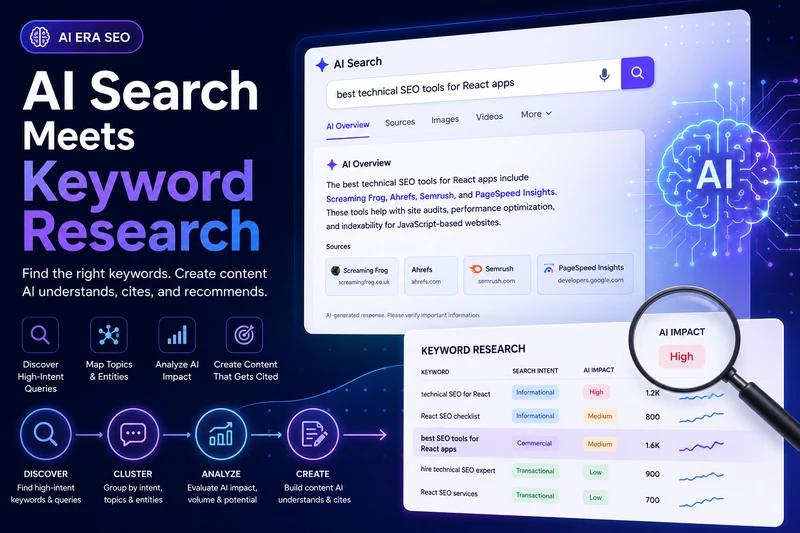
Keyword research in the AI era means analyzing what people search for when Google AI Overviews, ChatGPT, Perplexity, and other AI search tools answer queries before users ever click a link. Traditional keyword research focused on finding high-volume terms you could rank for in blue-link results. AI-era keyword research requires understanding intent clusters, entity relationships, and answer optimization instead.
Google AI Overviews now appear on 15 to 25 percent of search queries according to internal 2026 studies. Over 55 percent of searches end without a click according to SparkToro research. Ranking number one no longer guarantees traffic, so you must optimize for visibility in AI-generated answers, not just traditional SERP positions.
This guide covers how to adapt your keyword research process for both traditional search rankings and AI search visibility. You will learn specific prompt workflows, tool strategies, and measurement frameworks that work in 2026.
1. How Has AI Search Changed Keyword Research?
Traditional keyword research focused on exact-match terms and search volume. You found keywords with high monthly volume, built pages around them, and tracked rankings. AI search changed this in three fundamental ways.
First, conversational queries replace short-tail keywords. Users now type "How do I fix a React hydration error in Next.js 15" instead of "Next.js hydration error fix." AI search engines prefer natural language patterns over keyword-stuffed phrases.
Second, answer extraction means AI agents pull content from across the web through agentic web search and synthesize it. Your page may appear in an AI answer without the user ever searching the exact phrase you optimized for. Topic authority matters more than keyword density.
Third, zero-click dominance changes how you measure success. A keyword that triggers an AI Overview may send zero clicks to any website, yet your brand visibility increases when your content is cited. You must track brand mentions in AI responses, not just organic clicks.
2. What Is the Difference Between Keywords, Topics, and Entities?
Keywords are the literal search terms users type. Topics are broader subject areas that encompass multiple keywords. Entities are real-world concepts, people, places, and things that search engines understand as discrete objects with attributes and relationships.
In the AI era, entity-based research outperforms keyword-based research. Google's Knowledge Graph connects entities like "Google Search Console," "JavaScript SEO," and "canonical tags" as related concepts. An AI assistant understands these relationships and can answer compound questions without the user typing each term separately. Our technical SEO for AI guide covers entity optimization in more depth.
Your keyword research should identify the entities in your niche and map their relationships. A site about technical SEO should map entities like "Core Web Vitals," "lazy loading," "render budget," and "CLS optimization" as a connected cluster, not isolated keywords. This entity map becomes your content blueprint for AI search visibility.
3. How to Classify Keywords by AI Impact Using a 3-Tier Framework
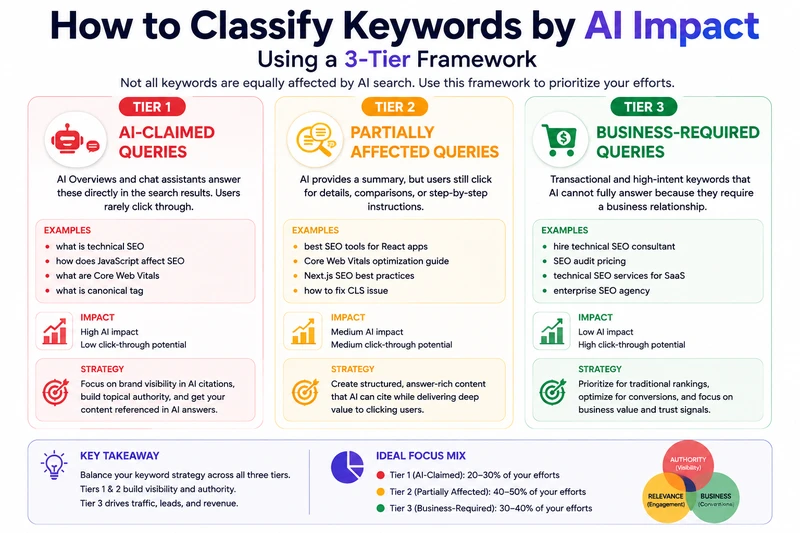
Not all keywords are equally affected by AI search. The WordStream 2026 framework classifies keywords into three tiers based on how AI Overviews and chat assistants handle them.
Tier one: AI-claimed queries. These are generic informational keywords like "what is technical SEO" or "how does JavaScript affect SEO." AI Overviews and ChatGPT answer these directly in the search result. Users rarely click through. Your strategy for tier one is brand visibility in AI citations, not traffic generation.
Tier two: Partially affected queries. Keywords like "best SEO tools for React apps" or "Core Web Vitals optimization guide." AI provides a summary but users still click for details, comparisons, or step-by-step instructions. These keywords require structured, answer-rich content that AI can cite while delivering value to clicking users.
Tier three: Business-required queries. Transactional and high-intent keywords like "hire technical SEO consultant" or "SEO audit pricing." AI cannot fully answer these because they require a business relationship. These keywords still drive clicks and conversions. Prioritize tier three for traditional ranking optimization.
4. How to Use AI Tools for Seed Keyword Expansion
AI tools like ChatGPT, Claude, and Gemini excel at expanding seed keywords into semantic clusters. Start with 5 to 10 core seed keywords related to your topic. Ask the AI to generate related terms, synonyms, and long-tail variations organized by search intent.
A proven prompt structure is: "I am researching [topic]. Generate 50 related keywords grouped by search intent: informational, commercial, navigational, and transactional. For each group, include conversational long-tail variations that users might ask AI assistants."
This approach produces richer keyword lists than traditional keyword tools because AI understands semantic relationships rather than just co-occurrence data. You must verify search volumes and competition using traditional tools like Ahrefs, Semrush, or Google Keyword Planner afterward.
5. How to Find Competitor Keyword Gaps Using AI
Competitor keyword gap analysis reveals terms your competitors rank for that you do not. AI accelerates this process by analyzing competitor content patterns and identifying thematic gaps that traditional tools might miss.
Enter your top three competitors' domains into a keyword gap tool like Ahrefs' Content Gap or Semrush's Keyword Gap. Export the missing keywords. Feed this list into an AI with a prompt that categorizes terms by search intent and priority.
AI identifies patterns across hundreds of keywords faster than manual sorting. It can also suggest content angles for each gap keyword, such as "create a comparison guide," "write a troubleshooting tutorial," or "optimize an existing page for this variant."
6. How to Find Low-Hanging Fruit and Traffic Decay Keywords
Low-hanging fruit keywords are terms where your site ranks on page two or three, needing only a content refresh to reach top positions. Traffic decay keywords are terms where your rankings have declined over the past 6 to 12 months.
Use Google Search Console to export your average position data. Filter for keywords ranked between positions 4 and 20 with meaningful impressions. These are your low-hanging fruit candidates. For traffic decay, compare last 3 months against the previous 3 months and identify keywords with position drops of 3 or more spots.
Feed these lists into an AI with instructions to recommend specific content updates for each keyword. Focus on adding structured data, updating statistics, expanding thin sections, and adding internal links. This targets effort where ranking improvement is most achievable.
7. How to Optimize for Conversational and Long-Tail Queries
AI-powered search favors conversational, multi-word queries over short keyword strings. Users speaking to ChatGPT, Perplexity, or Google's AI Mode ask full questions like "What is the best way to optimize images for Core Web Vitals in a React SPA?"
Use People Also Ask boxes and related question data from Google Search Console. These reveal the natural language patterns users actually employ. Export the question-based queries your site already appears for and expand them into comprehensive answer content.
Generate 50 question-based long-tail keywords related to your topic. Focus on comparison questions with "vs," how-to questions, and what-is questions. Include specific phrasing users would use when asking an AI assistant versus typing into a search bar. These conversational variations trigger AI Overviews and voice search results most frequently.
8. How to Find and Target Featured Snippet and AI Answer Opportunities
Featured snippets are the direct answers Google shows at position zero. AI Overviews and ChatGPT answers draw from the same content sources. Optimizing for featured snippets effectively optimizes for AI answers as well.
Identify keywords where your site ranks on page one but does not have a featured snippet. Use Ahrefs or Semrush to filter for keywords with featured snippet SERP features. Also look for keywords where the current snippet is weak, outdated, or from a low-authority domain.
Structure your content to answer the query directly in the first 50 to 100 words. Use clear definitions, numbered steps, or table-based comparisons. Format answers as self-contained blocks that AI agents can extract without needing surrounding context.
9. How to Build a Keyword Pipeline for Both Traditional and AI Search
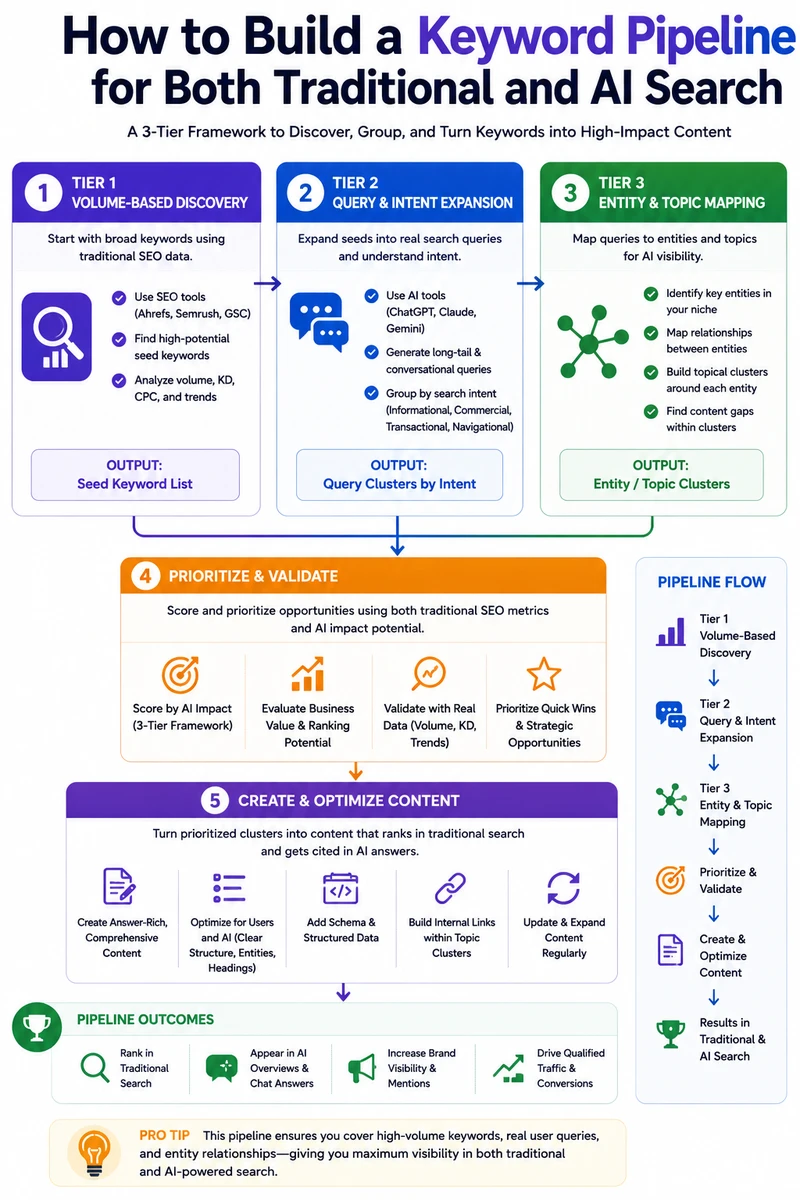
A modern keyword pipeline has three tiers. Tier one covers high-volume, commercially valuable keywords optimized for traditional blue-link rankings. Tier two covers question-based and conversational keywords optimized for AI Overviews and featured snippets. Tier three covers entity and topic clusters that build topical authority over time.
Use traditional keyword tools for tier one volume and competition data. Use AI tools for tier two conversational query discovery. Use entity extraction and knowledge graph analysis for tier three conceptual mapping.
Each piece of content should target one primary keyword from tier one, three to five secondary keywords from tier two, and establish entity coverage for tier three. This layered approach protects your traffic whether the user clicks a blue link or gets an AI-generated answer.
10. How to Measure Keyword Success When Clicks Are Not the Goal
Traditional keyword success metrics focus on rankings, click-through rates, and organic traffic. AI-era keyword success includes brand visibility in AI answers, citation rates in AI-generated content, and answer appearance frequency.
Track AI visibility by manually checking how your site appears in ChatGPT, Perplexity, and Google AI Overviews for your target keywords. If your brand is consistently missing from AI answers, our guide on why your brand is invisible to AI explains the root causes. Use tools like Brand24 or Mention to monitor brand citations across AI platforms. Compare your AI citation rate against competitors.
Set up custom reports in Google Search Console that track impressions for keywords triggering AI Overviews separately from traditional results. Monitor your zero-click impression share over time. If impressions rise while clicks fall, your content is being used as a source in AI answers, which still builds brand authority.
11. What AI Tools Should You Use for Keyword Research?
Tool selection depends on budget and workflow preferences. ChatGPT and Claude are effective for seed expansion, gap analysis, and prompt-based clustering. Ahrefs and Semrush remain essential for volume data, competition analysis, and rank tracking.
For AI-specific search analysis, try Perplexity Pages to see how AI sources and cites content. Google Search Console provides real query data including question-based queries and AI Overview triggers. AlsoAsked.com visualizes People Also Ask data for conversational keyword discovery.
For entity-based research, use Google's Natural Language API to extract entities from top-ranking content. InLinks and WordLift offer entity-based SEO analysis tailored to knowledge graph optimization. Nightwatch provides AI-powered keyword clustering and SERP pattern analysis with its AI SEO Agent.
For Answer Engine Optimization specifically, Reddit and Quora searches reveal the natural language questions real users ask. Industry forums provide question clusters that traditional keyword tools miss entirely. Combine forum data with AlsoAsked visualizations and our guide on optimizing content for AI search for a complete AEO keyword picture.
12. Common Mistakes in AI-Assisted Keyword Research
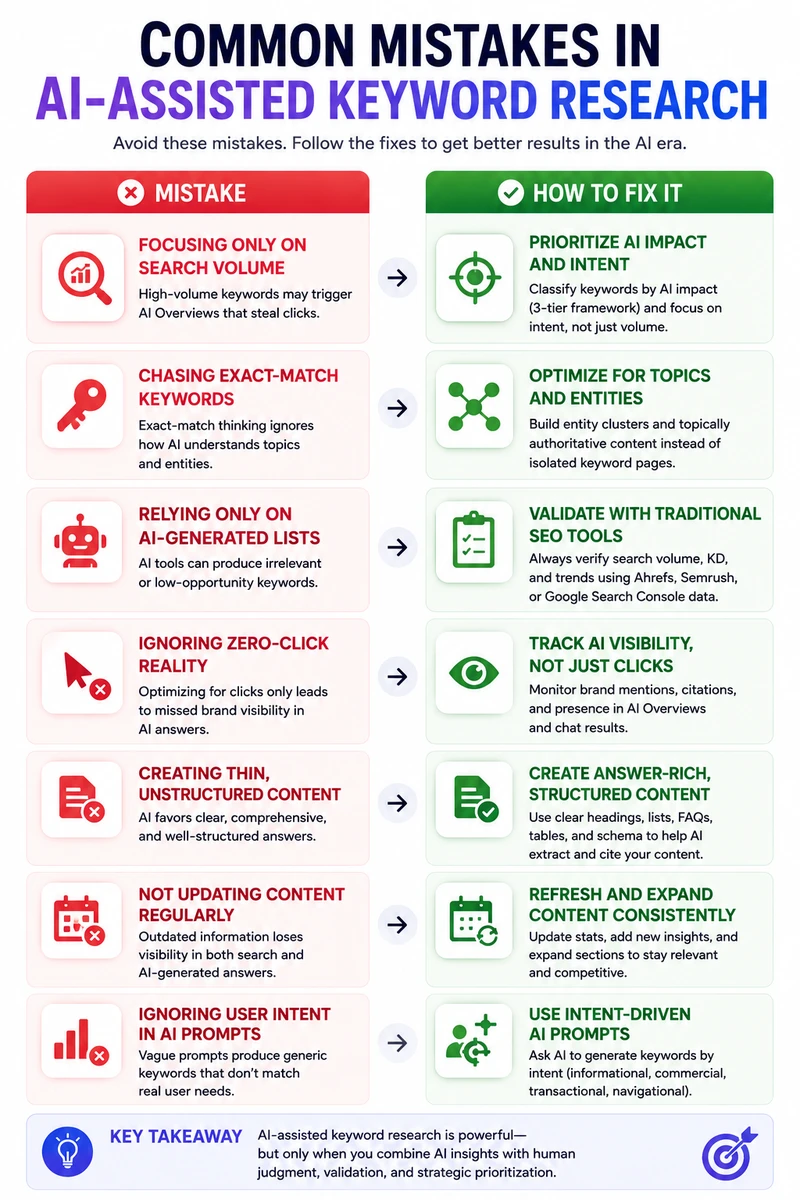
The most common mistake is trusting AI-generated keyword data without verification. AI tools hallucinate search volumes, invent competitor rankings, and suggest keywords with zero search intent. Always cross-reference AI suggestions with real keyword tool data before committing resources.
Another mistake is ignoring search intent in favor of keyword volume. A keyword with high volume but mismatched intent will never convert or rank well. AI tools often miss intent signals, so manual intent validation is essential. The Kuipra framework recommends conceding generic informational terms and focusing on comparative and transactional keywords instead.
Over-clustering is a growing problem. AI tools group hundreds of keywords into clusters, leading to content plans that are too broad to execute. Limit clusters to 5 to 15 keywords per content piece. Each cluster should represent one clear search intent.
The third mistake is optimizing exclusively for AI answers while neglecting traditional blue-link fundamentals. Google still generates over 60 percent of search traffic through traditional organic results as of 2026. Your strategy must serve both channels, not choose one over the other.
13. Frequently Asked Questions
Can AI do keyword research on its own? AI can generate keyword ideas and clusters, but it hallucinates search volumes and misses intent signals. Always verify AI suggestions with tools like Ahrefs or Google Keyword Planner before publishing.
What is the best AI tool for keyword research? No single tool covers everything. Use ChatGPT for seed expansion and clustering, Ahrefs for volume and competition data, and Perplexity Pages for AI citation analysis.
How do I find keywords that work in both Google and AI search? Focus on question-based queries, comparison keywords with "vs," and transactional long-tail terms. Structure content as self-contained answers that AI can extract while delivering value to clicking users.
Is keyword volume still important in 2026? Volume alone is misleading. A keyword with 10,000 monthly searches that AI answers directly drives zero clicks. Prioritize intent and AI impact over raw volume numbers when building your keyword pipeline.
14. Future-Proofing Your Keyword Research Process
AI search tools evolve monthly. What works in ChatGPT today may change with the next model update. Build a process that adapts rather than a static checklist that becomes obsolete.
Invest in topical authority over single-page optimization. Sites with broad, deep coverage of a subject area are consistently cited by AI tools regardless of ranking algorithm changes. Create interlinked content clusters rather than isolated keyword-targeted pages.
Monitor AI search changelogs from Google, OpenAI, and Perplexity. When a new AI search feature launches, test how it handles your target keywords within the first week. Early optimization for new AI features provides a visibility advantage that lasts months.
Keyword research in 2026 is not about chasing volume. It is about understanding how AI interprets queries, where human expertise still matters, and which terms drive real business outcomes. Adapt your process, verify everything, and build for both blue links and AI answers.