Most community banks compete with national brands that spend ten times more on marketing. Size does not decide the winner in local search, though. A bank that ranks first for local mortgage, small business lending, and checking account queries wins the customers that matter. Local relevance beats national budgets in the search results that drive branch traffic.
Local intent dominates banking searches. Eighty percent of consumers check a bank website before opening an account, and most new accounts begin with a digital search. People look for a bank near them, a loan officer, or a branch open on Saturday. Google rewards institutions that answer those needs with accurate data, usable content, and real trust signals.
What Makes Community Bank SEO Different
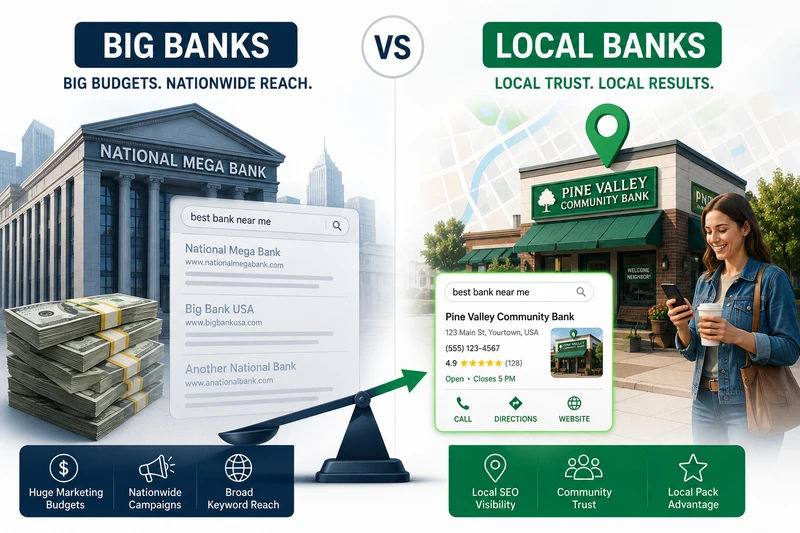
Community banks compete on relationships, local knowledge, and speed of decision-making. Search optimization must translate those strengths into ranking signals. A national brand wins with links and authority, while a local bank wins with proximity, consistency, and community proof. The strategy starts with the branch footprint, not with a keyword list.
The second difference is regulation. Banking content sits under strict advertising and privacy rules, so the approach must respect compliance at every step. Claims about rates and products need legal review before publication. This makes repeatable content systems more valuable than clever one-off campaigns that cannot pass compliance review.
Google Business Profile is the strongest asset a community bank owns. The profile shows hours, directions, services, and reviews in local results and Maps. A fully completed profile with real photos and category data lifts visibility by fifteen to twenty-five percent. Every profile update must stay synchronized with real branch changes, because local pack rankings hinge on freshness.
Pro tip: Treat every branch as its own local entity. Create a Google Business Profile and a location page for each branch. Local queries resolve around the branch address in Google Maps, so the branch entity matters more than the bank headquarters entity.
Core Local SEO Foundations for Community Banks
Three layers decide how Google evaluates a local business. Proximity and consistency feed the local pack, on-page relevance feeds organic results, and authority feeds both. Community banks most often lose on the first layer, because a mismatched phone number or an outdated branch page cancels everything else. The grouped lists below cover all three layers.
Local Search Foundations
- Google Business Profile complete with services, hours, and categories for every branch.
- NAP consistency across the website, profile, directories, and listing platforms.
- Local landing pages for each branch with unique content, not copied templates.
- Review velocity with a response to every review within 48 hours.
- Maps proximity signals strengthened by consistent, accurate citations.
On-Page Ranking Factors
- Location keywords in titles, headings, and first paragraphs of service pages.
- Content depth on products like mortgages, commercial lending, and treasury services.
- Page speed and mobile usability, since most local searches happen on phones.
- Internal linking from the homepage to each branch and product page.
Trust and Authority
- Backlinks from local chambers, universities, and community organizations.
- Digital PR around community events, grants, and local sponsorships.
- Consistent brand mentions with the bank name and location context.
Pro tip: Audit NAP consistency once per quarter across every directory and platform. A single outdated phone number is enough to suppress a branch from the local pack, and fixing it is the cheapest win in local SEO for any community bank.
The Community Bank SEO Strategy in Six Steps
The strategy runs in order because each step feeds the next. A branch audit prevents location errors from spreading into new content. Verified profiles give reviews a stable home, and service pages give those profiles something credible to point to. The full cycle becomes a quarterly operating rhythm instead of an occasional project.
- Audit the branch footprint and align every location page with real branch data.
- Complete and verify Google Business Profiles for the bank and every branch.
- Publish service pages for core products with local context and compliance review.
- Build citation and link assets through local partnerships and community programs.
- Publish a steady stream of loan and financial guides on the blog.
- Track local rankings, calls, and form submissions, then repeat what works.
Pro tip: Track calls and form submissions, not just clicks and rankings. A branch page can rank well and still fail if the phone number is not clickable or the form lands on a dead thank-you page instead of your sales queue.
Content That Ranks for Community Banks
Banking content ranks when it answers a real money question better than the national competitor. The keyword universe for a community bank is smaller than a national brand's, which makes every published page more valuable. Each piece should target one product, one audience, and one location angle. That focus satisfies both readers and ranking signals.
Financial Guide Content
- First-time home buyer guides that walk through the local mortgage process.
- Small business lending explainers written for local owners with revenue facts.
- CD ladder and deposit rate explainers with full rate disclosures.
- Checking and savings comparisons built around local branch access.
- Refinancing calculators and rate explainers for existing customers.
Community and Trust Content
- Local market reports that quote real neighborhood data and trends.
- Community event pages that document sponsorships and grants.
- Employee spotlight pages that build entity trust and personal credibility.
- Onboarding and cross-sell guides that turn new customers into long-term owners.
- FAQ pages answering the questions customers actually ask at branches.
A monthly cadence of two guides and one community story keeps the site fresh without exhausting the compliance team. Every guide follows the same template, so writers and reviewers know exactly what to expect. Over a year, the bank accumulates a library of pages that dominate long-tail local queries. That library becomes a moat that competitors cannot easily copy.
Pro tip: Repurpose top-performing branch questions into FAQ pages and short explainer posts on the blog. Real branch conversations are the best keyword research a community bank has available, and those questions arrive every single day at no cost to the marketing budget.
AI Search and Local Bank Visibility
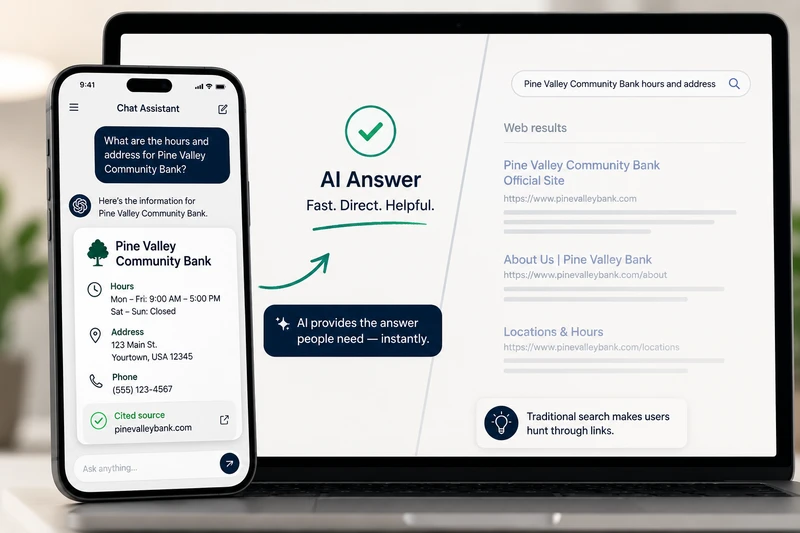
Search behavior has changed faster than most bank SEO plans. People now ask ChatGPT, Perplexity, and Google AI Overviews for banking advice before they open a browser tab. One regional bank ranks first on Google for a mortgage query yet was cited zero times across thirty AI prompts. Ranking and being cited are becoming separate battles.
The local signals that power classic rankings also feed AI answers, but presentation matters. AI systems prefer concise, structured answers with named authors and verifiable facts. A question-and-answer format turns a branch page into a citable source. Banks that publish financial guidance in this shape earn visibility in both search engines and the assistants sitting between customers and banks.
How AI Answers Pick Banks
- Question-and-answer formatting on product and branch pages.
- BankOrCreditUnion and LocalBusiness schema for fact extraction.
- Named authors and compliance reviewers on every financial guide.
- Local statistics and verifiable data woven into the copy.
- Consistent NAP data that matches across web and profile listings.
The same facts serve both audiences, so no extra publishing volume is needed. A branch page with hours, services, and a named manager answers a Google query and a ChatGPT prompt with the same content. The practical shift is structural, not creative. Formatting what already exists more clearly is the fastest way to become the answer.
Pro tip: Run a quarterly AI visibility audit. Ask ChatGPT, Perplexity, and Gemini ten questions about your products and branches, then compare their answers with your owned content. Where the assistants cite competitors, publish the missing answer in a Q&A format and track whether citations follow.
Common Community Bank SEO Mistakes
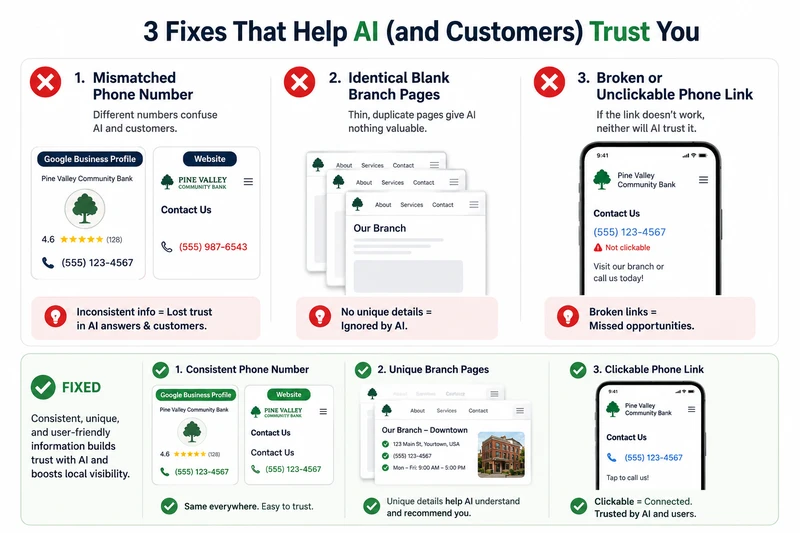
Most failed local programs share a small set of repeatable mistakes. The mistakes divide into compliance issues, consistency failures, and technical gaps. Each group has a distinctive symptom and a clear fix. The grouped lists below show the most common cases a community bank runs into when starting local search work.
Compliance and Consistency Mistakes
- Publishing rate or product claims without legal and compliance review.
- Letting branch details drift between the website, profiles, and directories.
- Writing identical location pages that Google treats as thin duplicates.
- Managing reviews in ways that violate platform or banking guidelines.
Technical and Strategic Mistakes
- Ranking the homepage for generic terms while branch pages stay invisible.
- Ignoring mobile performance when most local traffic arrives on phones.
- Running campaigns without call and form tracking on branch pages.
- Buying links from directories that regulators or Google consider low quality.
The compliance mistakes are the most dangerous because they carry regulatory weight beyond Google. The technical mistakes are the most common because they stay invisible until traffic drops. A quarterly review that covers all three groups keeps the program inside compliance and performance boundaries. Banks that treat local search as a governed process avoid most of these failures.
Pro tip: Give the compliance team a fixed review window every month and a simple content template. When reviewers approve one reusable pattern, every future page that follows that same pattern moves much faster through the entire content pipeline without repeated changes.
Compliance as an SEO Advantage
Compliance is usually described as a constraint, but a controlled review system becomes a publishing advantage. Deposit rate pages need Regulation DD disclosures covering APY, minimum balance, and rate terms. Advertising must carry the FDIC official name, and geo-targeted campaigns need a fair lending review. Banks that automate these steps publish faster than competitors, not slower.
Pre-approved templates turn the compliance bottleneck into a scaled machine. A template library for the ten most common promotion types reduces concept-to-launch time by half. Locked disclosure fields guarantee nothing slips, while flexible fields let the marketing team customize the offer. Regulators still review new formats, but repeat campaigns move through the pipeline in days.
Compliance Systems Every Bank SEO Program Needs
- Pre-approved campaign templates with locked disclosure fields.
- A quarterly audit of NAP, disclosures, and archived social media.
- Automatic archival of social posts, ads, and campaign assets.
- Documentation of fair lending checks for geo-targeted content.
- A fixed monthly window for compliance review of new content.
Pro tip: Align the marketing calendar with the compliance calendar. When reviewers publish a fixed review schedule, content teams plan against it instead of waiting in queues. The template library and review windows together cut the average time from approved idea to published page dramatically.
Local Schema and Structured Data for Banks
Structured data gives search engines precise facts about the bank without ambiguity. The Schema.org vocabulary includes BankOrCreditUnion for the institution itself and FinancialService for products like loans and accounts. Branch location pages can carry LocalBusiness markup with address and opening hours. This is the same entity-labeling approach used across modern technical SEO.
The markup matters for AI answers as well as classic search. When a search engine or AI agent needs the bank's hours, services, or address, labeled facts are easier to extract than text paragraphs. Consistent entities across the site make the whole domain more trustworthy to these systems.
Pro tip: Add BankOrCreditUnion markup to the homepage and LocalBusiness markup to every branch page. Keep the labeled name identical to the visible name in the page header, because any mismatch cancels the entity signal completely before ranking or AI extraction begins.
Frequently Asked Questions
How long does community bank SEO take to show results?
Most banks see local pack movement within two to three months and meaningful growth within six to nine months. The timeline depends on profile quality, content output, and citation consistency at the start. A bank with clean listings and verified profiles moves faster than one fixing legacy data problems. Local search rewards sustained consistency over quick campaigns.
Can community banks rank against national brands?
Yes, especially for local-intent keywords with a city or region attached. National banks win generic head terms like bank loans, while community banks win mortgage rates in Springfield or business checking near me. Proximity, profile quality, and local links outweigh national authority in the local pack. The community bank simply needs to pick the queries its footprint can win.
Does community bank SEO require paid advertising?
No, organic local search works without paid ads, and most community banks start with zero ad budget. Paid search can accelerate product campaigns, but the local pack and organic results depend on profiles, content, and citations. Many banks run purely organic programs successfully by prioritizing branch pages and reviews. Budget is better spent on content and listing management first.
What is the most important ranking factor for local banks?
Google Business Profile quality is the strongest single factor for local banking queries. Completeness, category accuracy, and fresh customer reviews decide local pack visibility more than any page element. NAP consistency and local landing pages come second, and authority links come third. The profile is the cheapest, fastest lever a community bank can pull today.