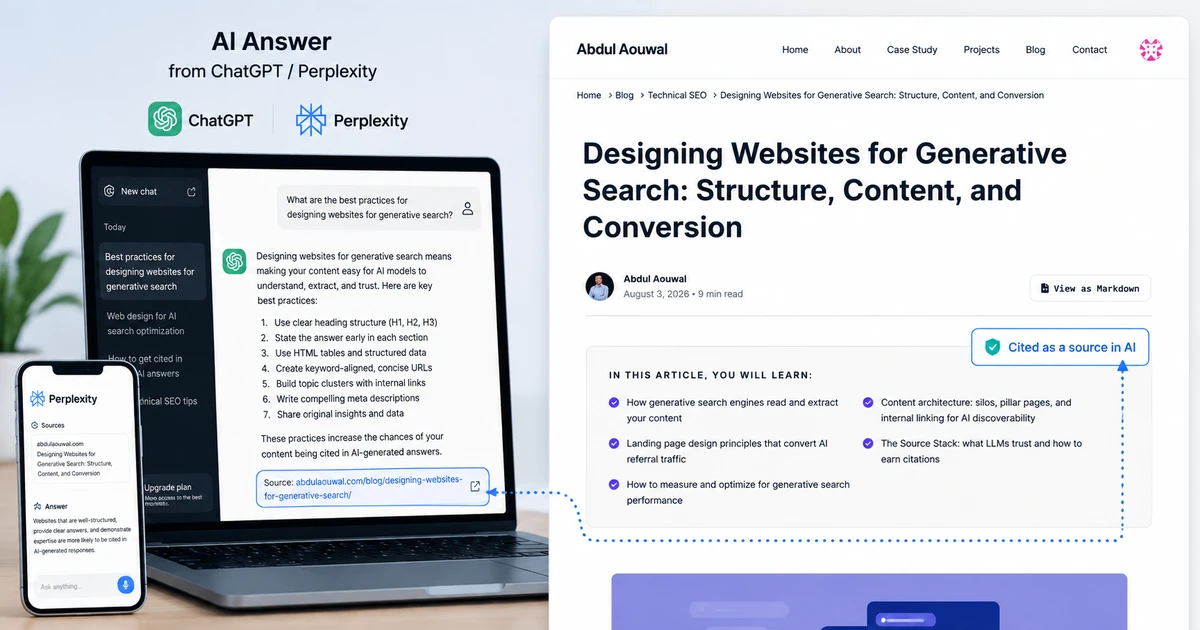
A growing share of web traffic now arrives through AI-generated answers. When someone asks ChatGPT, Perplexity, or Gemini a question and your page is cited in the response, that visitor arrives with unusually strong intent and expects to find exactly what the AI promised them before they clicked.
They have already evaluated alternatives, received a recommendation, and clicked through to act on that guidance. Aggregate data across 37 enterprise brands shows that visitors referred by AI tools convert at roughly 5.8% on average across all industry verticals studied.
In higher-stakes categories such as legal services, that figure climbs to 8.4% as decision urgency increases conversion propensity in these verticals. By comparison, organic search converts around 2% and paid search around 1.4% across the same dataset of enterprise brands tracked in the study.
This premium exists because the path to the page is fundamentally different. Traditional search returns a list of links that users scan and compare. Generative search returns a synthesized answer where your page is one of the cited sources. The visitor trusts the recommendation before they land. Your job is to design pages that meet that trust immediately.
The challenge is that generative search is less predictable than traditional search. Page positions in AI answers can shift 40% to 60% month over month based on model updates. Designing for this environment requires pages that serve two audiences: the AI model that decides whether to cite you and the human visitor who arrives ready to act.
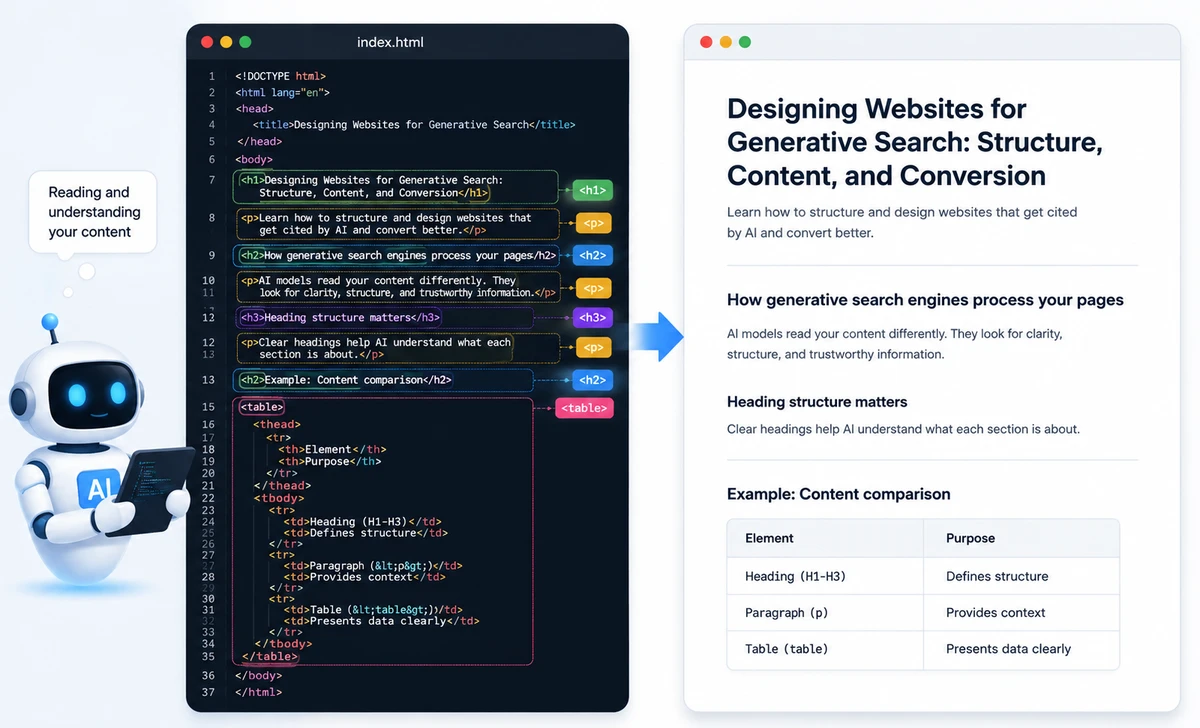
How generative search engines process your pages
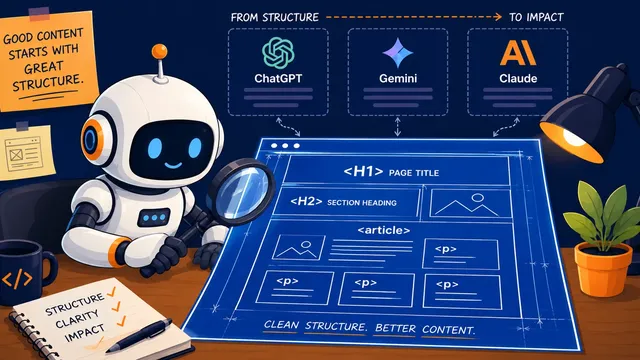
AI models do not view your website the same way a human visitor does through a browser. They read the raw HTML, follow the document structure, and evaluate text against the user's question. Several design elements determine whether your content gets included in the final answer generated for the user.
Heading structure tells the model what matters
When headings are absent or generic, the model cannot reliably map your content to specific questions users ask. A page with meaningful heading tags that describe each section clearly is far more likely to have its content pulled into an AI response. learn more about heading structure for generative search
State the answer before you provide context
A page that opens by answering a specific question is more useful to a generative search engine than one that leads with an introduction, background, or company overview. Each paragraph should deliver its key point in the first sentence to maximise extraction probability by the model.
Follow-up sentences can add detail and supporting context, but the model may truncate extraction after the first clear statement it finds in the paragraph. Place your strongest conclusion at the start of every paragraph to maximise your chances of being cited accurately by AI.
HTML tables and structured data preserve information during extraction
The same information inside an image or buried inside descriptive text is often ignored by AI models during extraction. Structured data markup in JSON-LD, especially FAQ schema, HowTo schema, and Product schema, tells the AI exactly what kind of information each section contains and increases the chance of accurate citation.
Your URL communicates page purpose before the model reads a word
Shorter, keyword-aligned URL paths are easier for AI models to evaluate and recommend in their generated responses. URLs that clearly describe the page topic help the model classify your content accurately before it processes the full document available across all channels.
Internal links build your reputation as a source on a topic
Organizing content into topic clusters with a main pillar page supported by several detail pages with cross-links between them signals depth of knowledge to AI models. Pages that exist as orphans with no internal connections carry less authority in the citation graph.
Your meta description often becomes the AI citation
Include the main takeaway, statistic, or recommendation in your meta description rather than a generic tagline. A meta description that reads as a clear summary of benefits is far more likely to be quoted by AI than one written as a marketing slogan.
Original insight outperforms rewritten common knowledge
A page based on personal testing, proprietary data, or direct experience provides genuine information gain to readers and models alike. Pages that rephrase existing content offer nothing new and are significantly less likely to be cited by AI systems in responses.
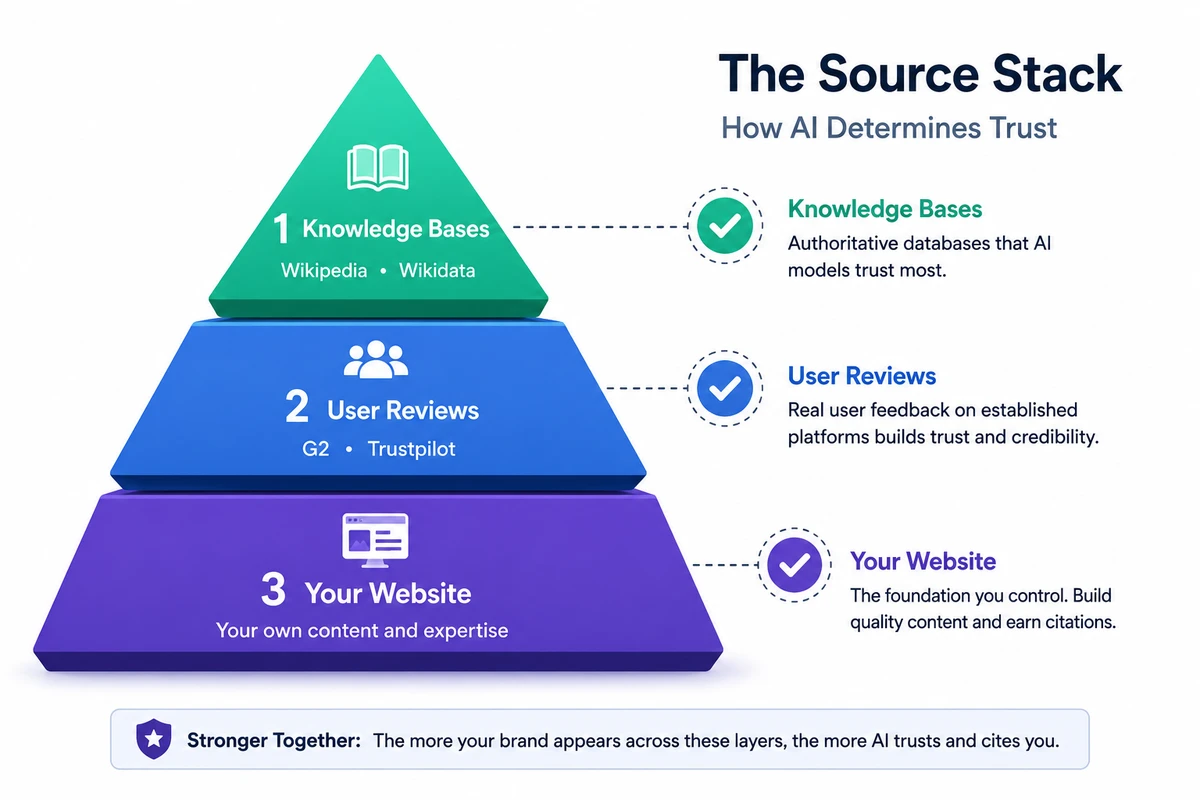
What makes a source trustworthy to an AI
AI models rank sources along a hierarchy of trust that determines which pages get cited in generated answers. Understanding this hierarchy helps you decide where to invest optimisation effort for the best return on your time, effort, and available resources.
Authoritative knowledge bases carry the most weight
Building your presence in these authoritative databases creates a foundation for all other citation efforts you pursue and expand on later. Being listed in trusted, verified knowledge sources signals to AI that your information meets a baseline standard of accuracy and reliability.
User-generated content on established platforms also rates highly
A brand with positive, detailed reviews across multiple review platforms signals reliability to the model evaluating your content and its overall quality level today. Review volume, recency, depth, and response patterns all factor into how AI evaluates your brand trustworthiness.
Your own website is the base layer you have full control over
A complete strategy addresses all three layers of the trust hierarchy: verified external databases, user-generated consensus on established platforms, and well-structured owned content on your site. Each layer reinforces and validates the others in the model's overall citation decision process over time.
Pages that can be reached through multiple navigation paths increase the range of queries for which the model finds you relevant. A page accessible from several entry points is more likely to match diverse user questions across different search contexts.
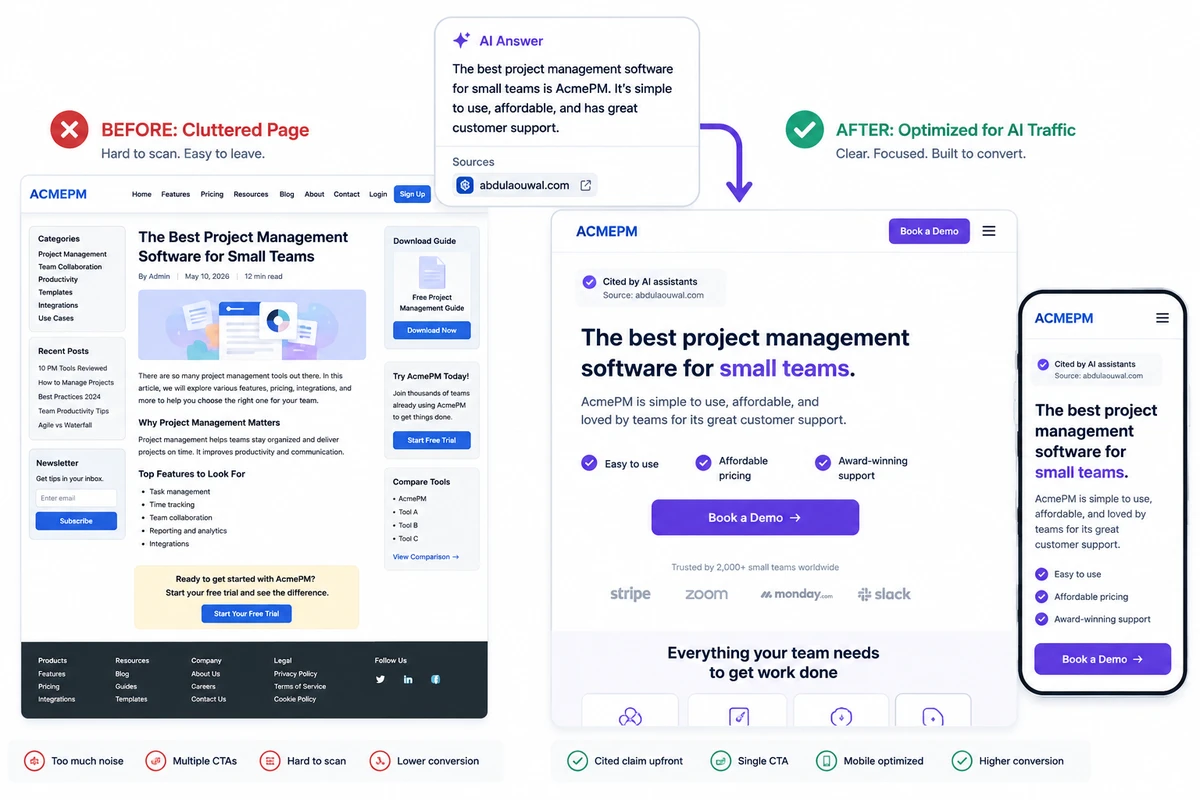
Designing pages that convert generative search visitors
Visitors who arrive through an AI answer expect to see exactly what the recommendation promised them in the response they received from the AI tool. This expectation creates specific design requirements that differ from traditional SEO landing page optimisation strategies and tactics.
Lead with the claim that earned the recommendation
Background information, brand introductions, and navigation prompts belong lower on the page below the content that the AI cited. Lead immediately with the specific claim or data point that earned you the recommendation in the first place from the AI.
Reduce the number of decisions the visitor must make
Asking them to learn more or explore options introduces unnecessary delay after they already decided to visit your page. The primary call to action should assume late-stage intent. Booking a demo or seeing pricing works better than generic exploration prompts.
Match the page structure to what the AI quoted
A mismatch between what the AI described and what the visitor sees on arrival creates doubt about the page's relevance. The visitor may wonder if they landed on the correct page and leave immediately without engaging further with your content.
Optimize for the device AI conversations happen on
Pages that load slowly, display poorly, or truncate content on mobile devices lose these visitors before they engage with your content at all. The mobile experience must be as complete and fast as the desktop version to capture this traffic effectively.
FAQ sections naturally attract AI extraction
Marking this section with FAQ structured data in JSON-LD format helps the model identify and extract the pairs reliably and accurately from your content on every visit. FAQ content maps directly to the question-answer format that AI models prefer for citations.
Measuring your generative search visibility
Tracking traffic from generative AI sources requires combining several data signals because no single analytics tool captures it all comprehensively on its own in every case. A multi-signal measurement approach gives you the most accurate picture of generative search performance over time.
Google Search Console now includes dedicated reports for AI Overviews and AI Mode under Search Appearance and performance settings. These show how often your pages appear in Google's generative search features across different query categories, topics, and related content types.
Check these reports on a regular basis to understand baseline visibility and identify pages that appear frequently in AI results and direct answer content. Growing appearance counts and trend direction indicate your optimisation efforts are working as intended over time.
In Google Analytics, generative search traffic often appears as direct sessions because many AI tools do not send a referrer header with the request. Create a custom segment for direct sessions landing on pages you know appear in AI responses.
Compare conversion rates between these direct sessions and your organic traffic to quantify the premium that generative search delivers to your site over time. The difference reveals how much extra value AI citations provide over traditional search rankings and benchmarks.
Branded search query growth can also indicate increased AI citation activity. When AI models recommend your page, more users search for your brand name afterward. Monitoring branded query volume in Search Console over time gives an indirect signal of generative search visibility.
Combine these data sources into a single dashboard view that tracks page, session source, and conversion action together into one unified report. Pages with high direct traffic and high conversion rates are strong candidates for additional optimisation and testing work.
As more users turn to AI tools for answers, the websites that earn citations and convert visitors on the landing page will capture a growing share of qualified traffic. The key is designing for the model that decides whether to cite you and for the visitor who acts on that citation.
Frequently asked questions
What is generative search?
Generative search refers to AI tools like ChatGPT, Perplexity, and Gemini that produce synthesised answers from multiple web sources. Rather than displaying a ranked list of links for browsing, these tools present a concise answer to the user's question with citations.
How does designing for generative search differ from traditional SEO?
Traditional SEO focuses on ranking in a list of search results returned by a search engine. Designing for generative search focuses on how an AI model reads, extracts, and cites your content in a synthesised response presented directly to users.
Which page element matters most for generative search visibility?
Heading hierarchy is the single most important page element for AI visibility in generative search. Clear H1, H2, and H3 tags let AI models map your content to user questions and cite specific sections with confidence, accuracy, and full context for the best results.
How can I tell if generative search is sending traffic to my site?
Check Google Search Console for AI Overviews appearance data on a regular basis and create a GA4 segment for direct traffic on pages that commonly appear in AI responses. Rising branded search volume is another strong indicator of growing generative search visibility.
What is the Source Stack?
The Source Stack is the three-layer hierarchy of trust that AI models use when deciding which sources to cite in answers. It ranges from verified knowledge bases at the top through user-generated content on established platforms to your own website assets at the base. See our guide on AI SEO for more details. See our guide on Core Web Vitals for more details.