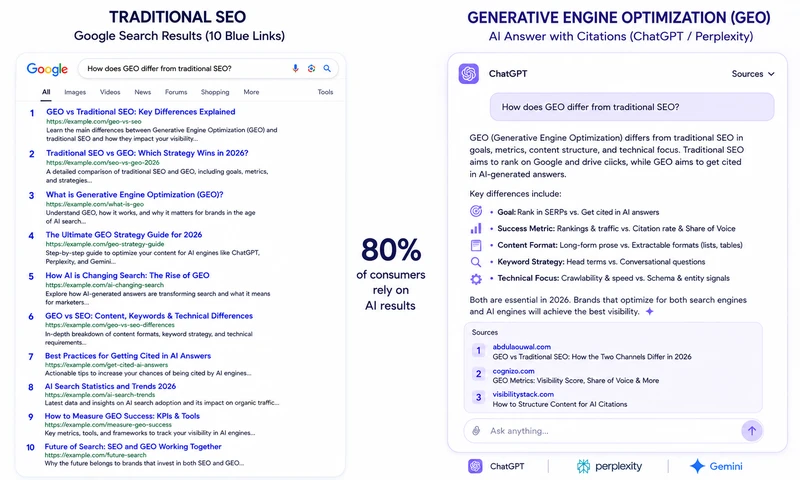
Generative Engine Optimization emerged as a distinct discipline in 2025 as AI engines began routing traffic away from traditional search results. Traditional SEO optimises for Google's ranking algorithm, while GEO optimises for AI answer generation and citation. The two require different strategies, metrics, and content structures that complement each other.
The scale of this shift is backed by hard data. A Bain-Dynata survey found 80% of consumers rely on AI-written results for at least 40% of searches, reducing organic web traffic by 15% to 25%. SparkToro reports 58.5% of US Google searches now end without clicking on any result.
Gartner predicts a 25% decline in traditional search engine volume by 2026. These trends make the GEO versus traditional SEO distinction essential for brands investing in search visibility across both search and AI channels for sustained performance and traffic growth.
| Dimension | Traditional SEO | Generative Engine Optimization |
|---|---|---|
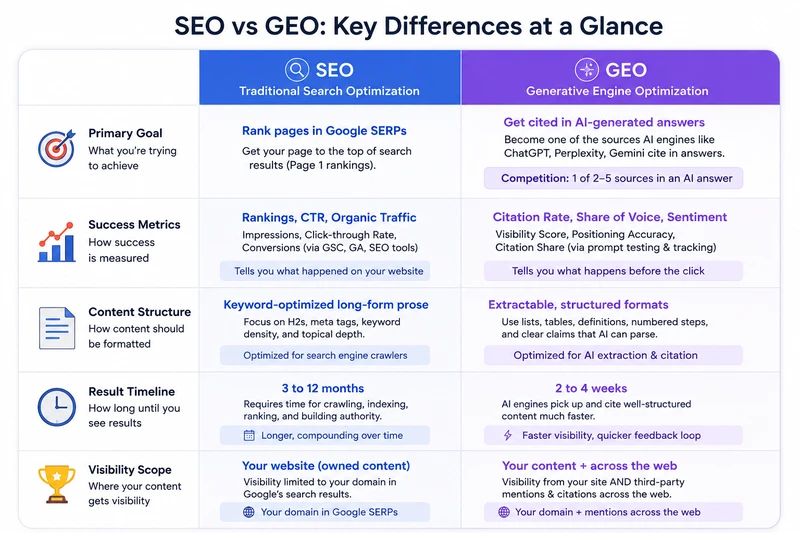
| Primary Goal | Rank pages in Google SERPs | Get cited in AI-generated answers |
| Success Metric | Position, CTR, organic traffic | Citation rate, Share of Voice, Sentiment |
| Content Format | Keyword-optimised long-form prose | Extractable formats like lists, tables, definitions |
| Keyword Strategy | Head terms by search volume | Conversational question forms by AI prompt match |
| Technical Focus | Crawlability, speed, meta tags | Schema markup, entity extraction, AI-cited domain links |
| Entity Role | Topical relevance signal | Direct citation anchor |
| Measurement Tools | GSC, Ahrefs, Semrush, GA | Prompt testing, citation monitoring scripts |
| Result Timeline | 3 to 12 months | 2 to 4 weeks |
| Competition Unit | One of 10 blue links | One of 2 to 5 cited sources in one AI answer |
| Visibility Scope | Owned content on your domain | Owned content + third-party mentions across the web |
1. Primary Goal
Traditional SEO aims for Page 1 ranking in Google's organic results. Every optimisation targets a higher position for a specific keyword, with the assumption that higher ranking drives more clicks and conversions. GEO aims for AI citation inclusion, ensuring the site's content appears as a referenced source in AI-generated answers across ChatGPT, Perplexity, Gemini, and Google AI Overviews.
As Rankshift describes it, ranking signals and citation signals are not the same thing. Traditional SEO competition means one page among ten blue links. GEO competition means one of two to five sources cited in a single AI answer, a fundamentally different unit of competition.
AI engines synthesise answers from multiple sources and cite only the most parseable and trustworthy content available. A page strong in traditional SEO registers zero citations across the major AI platforms entirely when it lacks extractable formatting and clear claims.
2. Success Metric
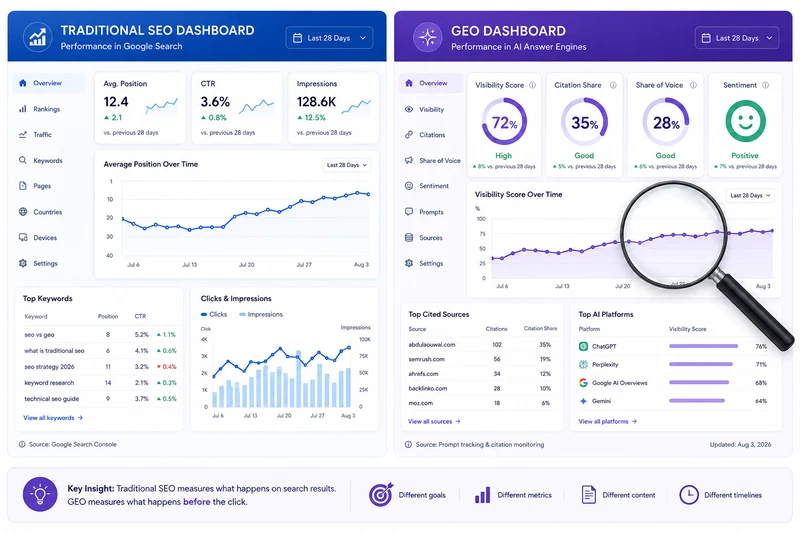
Traditional SEO tracks position, organic click-through rate, impressions, and conversion rate through Google Search Console and analytics platforms. These metrics measure visibility within Google's blue-link SERP but tell nothing about whether AI engines reference the content in answers. None of the GEO metrics described below appear in any traditional SEO dashboard.
GEO shifts the metric to five KPIs from Cognizo: Visibility Score, Share of Voice, Citation Share, Positioning Accuracy, and Sentiment. A page with a 35% citation rate across ChatGPT, Perplexity, and Gemini outperforms one ranking first on Google with zero AI citations. As Cognizo notes, SEO tells what happened at your website while GEO measures what happened before the click.
3. Content Structure
Traditional SEO structures content around keyword-optimised H2 headings, meta descriptions, title tags, and keyword density in body paragraphs. The format prioritises search engine crawlers that parse HTML structure for relevance signals. GEO structures content around extractable formats like bullet lists, comparison tables, step-by-step numbered instructions, and dictionary-style definitions that AI engines can parse without editorial interpretation.
VisibilityStack's research shows that AI engines require the answer in the first sentence for extraction. A page opening with context before the answer will not be cited because the AI cannot extract a clean claim. The same content restructured to lead with a direct definition saw citations jump within three weeks without changing keyword density or backlinks.
4. Keyword Strategy
Traditional SEO targets exact-match and phrase-match keywords identified through volume-based keyword research tools. The strategy prioritises head terms with high monthly search volume and manageable keyword difficulty scores, even when those keywords appear as click-only results without AI engagement. The approach assumes the user will scan a list of links and choose one to visit.
GEO targets conversational long-tail queries that match how users prompt AI engines. A query like how does GEO differ from traditional SEO has near-zero search volume but directly matches how a user asks ChatGPT. When content answers that prompt, ChatGPT cites it in the AI answer. The GEO keyword strategy prioritises question form over volume for citation-driven visibility.
5. Technical Requirements
Traditional SEO requires crawlability, indexability, fast page speed, mobile responsiveness, clean URL structure, and proper XML sitemaps. These fundamentals remain necessary for both disciplines, and no AI engine can cite content it cannot crawl. GEO inherits all these requirements and adds structured data optimized for entity extraction and knowledge graph population.
A page with perfect traditional SEO still lacks the schema AI engines need. Adding FAQ, HowTo, and Article schema with entities transforms it for GEO. VisibilityStack reveals Reddit appears in 49% of AI Overviews. The top five cited domains account for 38% of citations. Backlinks from high-citation domains carry more GEO weight than links from high-PageRank domains rarely cited.
6. Entity Approach
Traditional SEO targets keywords while GEO targets entities, the nouns and concepts that AI engines extract and link to knowledge graphs. Traditional SEO uses entities as topical relevance signals. When Google processes a page about crawl budget, it recognises related entities like indexation and server log analysis. The entities support the ranking signal but are not the primary optimisation target.
VisibilityStack illustrates this with the Asana example. A page optimised for the keyword project management software ranks for that phrase alone, but a page optimised for the entity Asana includes structured data that defines what it is and who it serves. AI engines cite the entity-optimised page because they can extract and attribute the claim directly without guessing its context.
7. Measurement
Traditional SEO measures performance through rank tracking tools like Ahrefs, Semrush, and STAT combined with Google Search Console data and analytics. These tools provide comprehensive visibility into traditional search performance but offer zero insight into AI citation behaviour. As Cognizo notes, a brand can lose ground in AI-generated answers for months while its SEO dashboard shows green.
GEO measurement requires dedicated citation monitoring through prompt testing on the major AI platforms. The five GEO KPIs are measured by submitting target keywords to ChatGPT, Perplexity, and Gemini, then logging whether the site appears as a cited source. Microsoft's research shows that 41% of consumers believe conversational AI search is more accurate than traditional search.
Zensciences reports that 67% of users notice AI summaries and 38% read them in half or more of their searches. This engagement shift makes GEO measurement essential for understanding brand presence in the channel consumers already prefer for their search needs.
8. Timeline
Traditional SEO operates on a 3-month to 6-month timeline for ranking improvements. Competitive niches require 6 to 12 months to see meaningful position changes. The delay comes from crawl frequency, indexing cycles, and link acquisition. GEO shows results in 2 to 4 weeks for citation visibility because AI engines incorporate new content into retrieval indices on a shorter cycle.
VisibilityStack reports that restructuring product pages to lead with a direct answer triggered citation jumps within three weeks. A guide on Perplexity citation can appear as a cited source within two weeks if the content matches the conversational format. The faster GEO timeline is ideal for testing content hypotheses, then using SEO to build sustained organic presence.
9. Competitive Landscape
Traditional SEO competition is measured through keyword difficulty scores, domain authority, backlink profiles, and content volume. Established sites with high authority dominate competitive head terms, and new entrants face a years-long uphill battle against incumbents for top positions. GEO competition is measured through citation concentration, or how many domains currently dominate AI answers for a specific topic.
VisibilityStack's data shows ChatGPT reached about 900 million weekly active users in early 2026. Google AI Overviews serve 2 billion monthly users. B2B buyers' use of generative AI in research ranges from 45% to 89%. Reddit appears in 49% of AI Overviews. The top five cited domains account for 38% of citations, while 62% spans niche sources with faster entry.
10. Integration Strategy
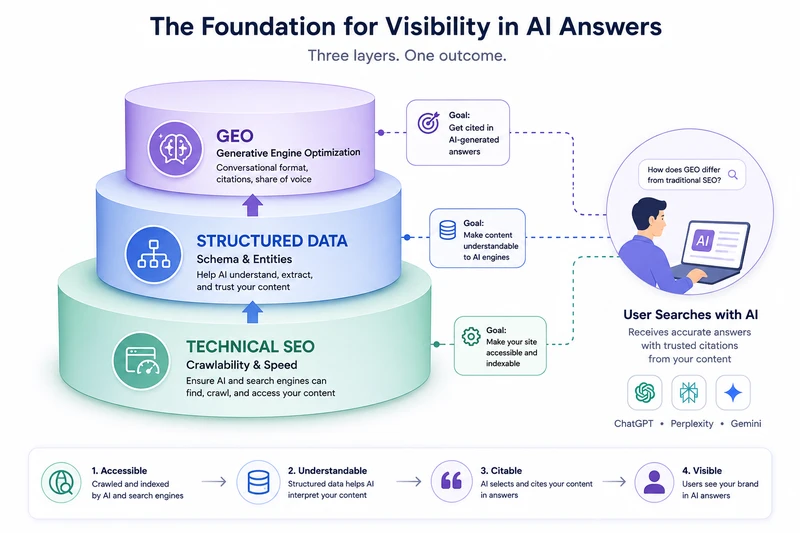
GEO and traditional SEO are not alternatives. GEO sits on top of a traditional SEO foundation. Strong technical SEO provides crawlability. Structured data adds the entity layer for citation. Conversational keyword research identifies AI-answered queries. The three layers together form a complete AI-era search strategy.
VisibilityStack frames this as one piece of content serving three endpoints. A direct answer in the first sentence serves GEO extraction. Entity-specific headings and schema serve both GEO and SEO. Deep expertise builds content authority. The workflow begins with an SEO audit, adds structured data, identifies conversational keywords, and monitors citation rate across AI platforms weekly.
Frequently Asked Questions
Do I need to choose between GEO and traditional SEO?
No. Strong traditional SEO provides the technical foundation that GEO requires to function effectively. The two strategies target different user intent layers, where traditional SEO captures click-through traffic and GEO captures AI citation visibility with downstream brand exposure. Ryze AI found that sites using both strategies saw measurable improvements across all search platforms compared to SEO-only approaches.
Can GEO work without a strong traditional SEO foundation?
Partially. AI engines cannot cite content they cannot crawl, so crawlability is a prerequisite. However, a site with weak backlinks can still earn AI citations if content matches conversational format. GEO rewards format and parseability over PageRank. As Rankshift summarises, you do not win at GEO by being the loudest result but by being the cleanest source.
How do I split my budget between GEO and traditional SEO?
Allocate 70% to fixing technical SEO fundamentals first, then 30% to GEO restructuring. Once basics are solid, reverse to 30% maintenance and 70% GEO expansion. Citation concentration in AI engines is lower and competition less saturated. For brands where B2B buyers already use AI for purchase research, GEO urgency justifies an earlier split reversal.
Will GEO replace traditional SEO entirely?
Not in the near term. Google's AI Overviews coexist with traditional blue links. Many commercial queries trigger click-through results, not AI summaries. The two channels serve different intents where SEO answers which page is relevant and GEO answers the question directly. Brands need visibility in both to capture the full search market.