
Niche selection used to depend on search volume, CPC, and competition scores. Those metrics worked for a search engine that ranked pages by keyword density. AI engines replaced that system. Now a niche's value depends on how often LLMs reference content in that space and whether citations come from authoritative clusters or scattered single pages.
The framework below introduces 10 factors. They replace the outdated keyword-centric approach to niche evaluation. Each factor measures a different dimension of AI-era niche viability, from citation concentration and entity density to the human judgment gap that determines whether content can differentiate itself from AI-generated summaries. Together they form a complete methodology for choosing a niche that AI engines will recognise, cite, and recommend.
What Is a Niche in AI?
A niche in AI is a distinct topic space that large language models can recognise, cite, and recommend to users. It is not defined by search volume or keyword difficulty the way traditional SEO defined market segments. Instead, a niche earns value when AI engines repeatedly reference content in that space as an authoritative source for related queries.
A profitable AI niche has clear boundaries that separate it from adjacent topics. This lets the model attribute content to the right domain and surface it for user conversations. Niche clarity matters more in generative search than in traditional search, since the model must map a page to a concept before citing it in an answer.
1. Problem-Solving vs Review Potential
Niches divide into two types. Review-based niches require purchases, travel, or certifications. Problem-solving niches rely on research plus judgment. AI has lowered the barrier for problem-solving niches because researching and organising information no longer requires being a domain expert. Review-based niches still demand first-hand experience.
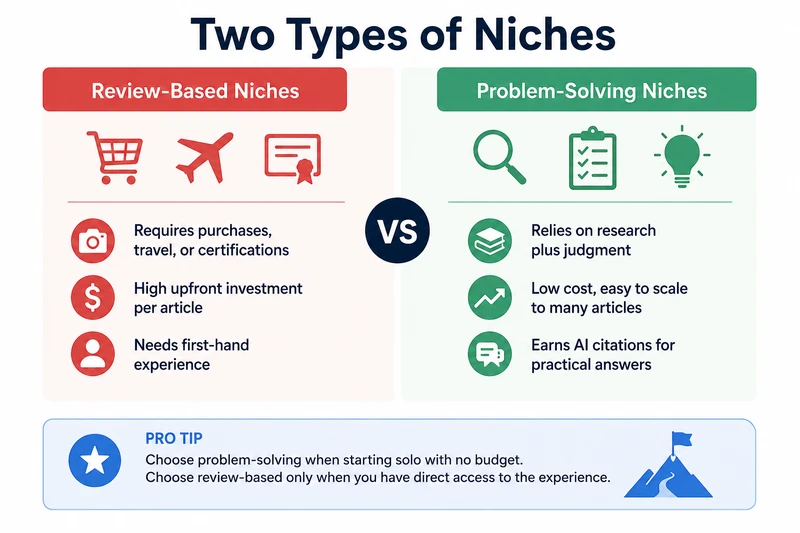
Consider one travel niche from two angles. "Travel gadgets review" requires buying gadgets, traveling with them, and taking photos. That is a high upfront investment per article. "First-time overseas trip preparation guide" organises official information, packing lists, and airport procedures with judgment added: "if you are a beginner, this is what you actually need." The problem-solving angle requires no ongoing purchases, scales to dozens of articles, and earns AI citations for answering practical questions rather than describing personal experience.
Pro tip: Choose problem-solving when starting solo with no budget for purchases or travel. Choose review-based only when you already own the products or have direct access to the experience. Sustain that across 20+ articles.
2. Judgment Gap Size
The value of human content in an AI-driven search landscape is proportional to the judgment gap. That gap is the distance between available information and the reader's need for a decision. Niches where readers compare options and need a recommendation reward human perspective. AI summaries present options without conviction. The reader leaves the AI answer knowing what exists but not what to choose.
"SEO tools comparison" has a wide judgment gap. Readers find many tools but want someone to say "this is the best for small businesses starting out." "DNS record types explained" has a narrow judgment gap. The answer is factual and offers little room for perspective. The tools comparison niche wins because human judgment provides differentiation that AI-generated balanced summaries cannot match, creating content that earns citations specifically for its decision-making value.
Pro tip: Target niches where the answer depends on context, such as "what is best for my situation" type questions. Avoid niches where the answer is identical regardless of who asks. AI handles those without needing human perspective.
3. AI Citation Concentration
Before entering a niche, measure how many domains currently dominate AI citations. A concentration score where 80% of citations go to three sites signals a high entry barrier. A fragmented landscape where ten or more sites share citations signals an opportunity. No single source has established dominance in the AI knowledge graph.
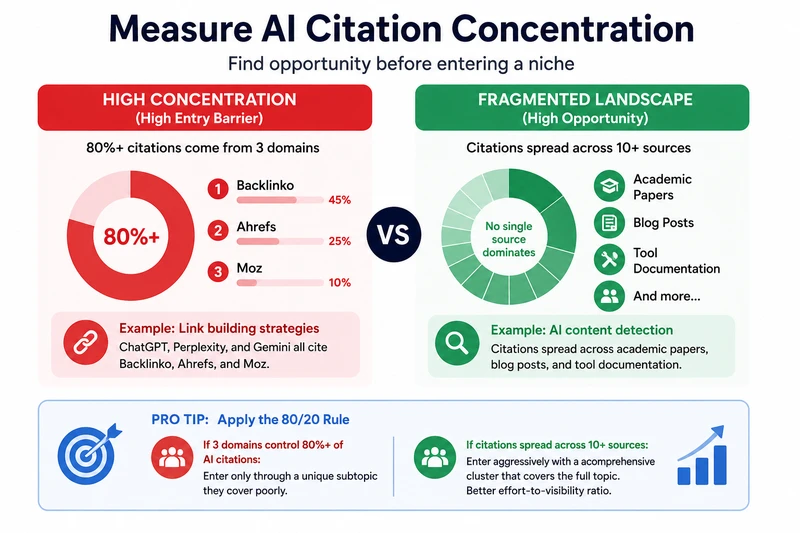
"Link building strategies" shows high citation concentration. ChatGPT, Perplexity, and Gemini all cite Backlinko, Ahrefs, and Moz. "AI content detection" shows fragmentation. Citations spread across academic papers, blog posts, and tool documentation. The fragmented niche wins because a single comprehensive content cluster can earn citations that no existing source currently owns. The effort-to-visibility ratio is far more favourable for a new entrant.
Pro tip: Apply the 80/20 rule. If three domains control 80% or more of AI citations, enter only through a unique subtopic they cover poorly. If citations spread across ten or more sources, enter aggressively with a comprehensive cluster that covers the full topic.
4. Entity Density
AI engines evaluate authority through entity relationships. They do not rely on page-level keywords alone. Niches with high entity density, meaning hundreds of interconnected concepts, tools, metrics, and standards, reward cluster-building. Every entity page reinforces the others. Sparse niches with few entities offer limited internal linking surface area and slower authority accumulation.
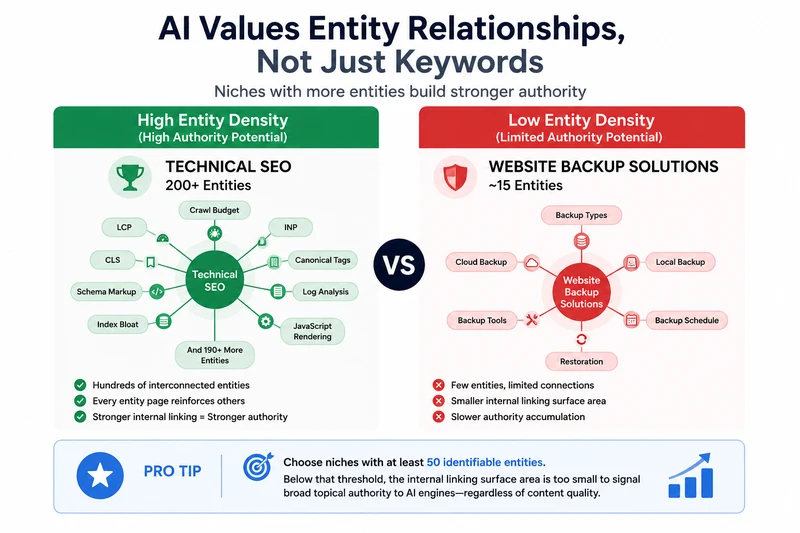
"Technical SEO" has over 200 entities: crawl budget, LCP, INP, CLS, canonical tags, schema markup, log analysis, index bloat, and JavaScript rendering among them. SEO freelancer vs SEO agency options require different strengths — the article helps you decide. "Website backup solutions" has approximately 15 entities. Technical SEO wins because each entity page strengthens the entire cluster through internal linking. AI engines recognise the interconnected knowledge graph as authoritative across all related queries in the niche.
Pro tip: Prefer niches with at least 50 identifiable entities. Below that threshold, the internal linking surface area is too small to signal broad topical authority to AI engines. This applies regardless of content quality.
5. Query Fan-Out
Query fan-out measures how many unique conversational variations a niche supports. High fan-out niches generate dozens or hundreds of distinct question formats that AI engines use as entry points. Low fan-out niches exhaust their question pool quickly. This caps the total number of queries your content can capture.
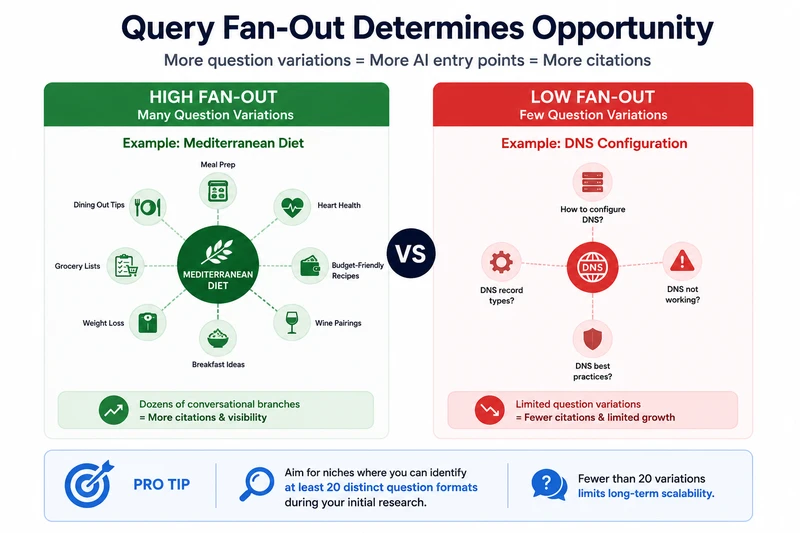
"Mediterranean diet" produces high fan-out. The variations include meal prep, heart health, budget-friendly recipes, wine pairings, breakfast ideas, weight loss, grocery lists, and dining out tips. Each is a distinct conversational branch. "DNS configuration" produces low fan-out, offering a few procedural queries with limited variation. The high fan-out niche wins because AI engines surface content through multiple query entry points. Each entry point represents a separate citation opportunity that compounds across the full conversation tree.
Pro tip: Aim for niches where you can identify at least 20 distinct question formats during your initial research. Fewer than 20 limits long-term scalability.
6. Experience Barrier Level
Not all niches are equally accessible. Some require physical experience, such as travel to destinations, hands-on product use, certifications, or regulatory compliance knowledge. Others can be researched and reconstructed without direct personal experience. A human must still verify accuracy and add perspective. The barrier level determines how quickly a solo creator can build depth in the niche.
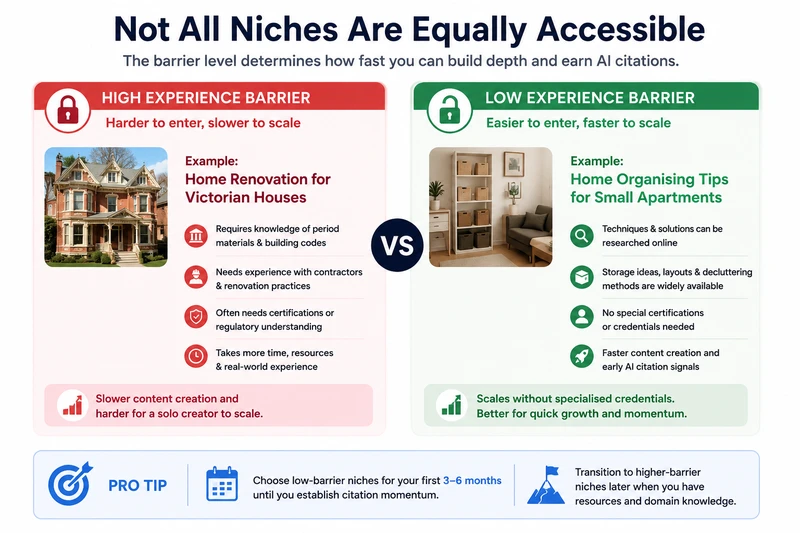
"Home renovation for Victorian houses" has a high experience barrier. It requires knowledge of period-appropriate materials, building codes, and contractor practices that cannot be fully researched online. "Home organising tips for small apartments" has a low experience barrier. Space-saving techniques, storage solutions, and decluttering methods can be researched and verified. The small apartments niche wins for a solo creator because it scales without requiring specialised credentials. It allows faster content accumulation and earlier AI citation signals.
Pro tip: Choose low-barrier niches for your first three to six months until you establish citation momentum. Transition to higher-barrier niches later when you have resources and domain knowledge.
7. Monetisation Through AI Recommendations
A niche's monetisation potential in the AI era depends on whether AI engines recommend products, services, or tools in their answers. Queries that trigger "best X for Y" or "top tools for Z" create natural affiliate and referral opportunities. Queries that trigger "consult a professional" or generic informational summaries offer limited direct monetisation through AI-driven traffic.
"Best project management software for remote teams" generates product recommendations from ChatGPT with affiliate potential. The AI engine names specific tools in its answer. "What is agile methodology" generates a definition with zero product mentions. The project management software niche wins because every AI citation that names a product creates a monetisation opportunity. The informational niche closes the purchase loop within the AI answer itself, leaving no reason for the user to click through.
Pro tip: Before committing to a niche, verify that its "best X for Y" queries actually trigger AI tool recommendations. Run three candidate queries through ChatGPT. If the AI answers "consult a professional" or gives generic advice without naming products, the monetisation path is blocked.
8. Emerging Niche Signals
The most valuable niches are those gaining AI visibility rather than losing it. Rising signals include new entities appearing in AI answers, expanding People Also Ask boxes, and growing Knowledge Panel entries. Declining signals include AI answers defaulting to "several sources discuss this" language. Static Wikipedia entries and decreasing question variety in SERP features are also warning signs.
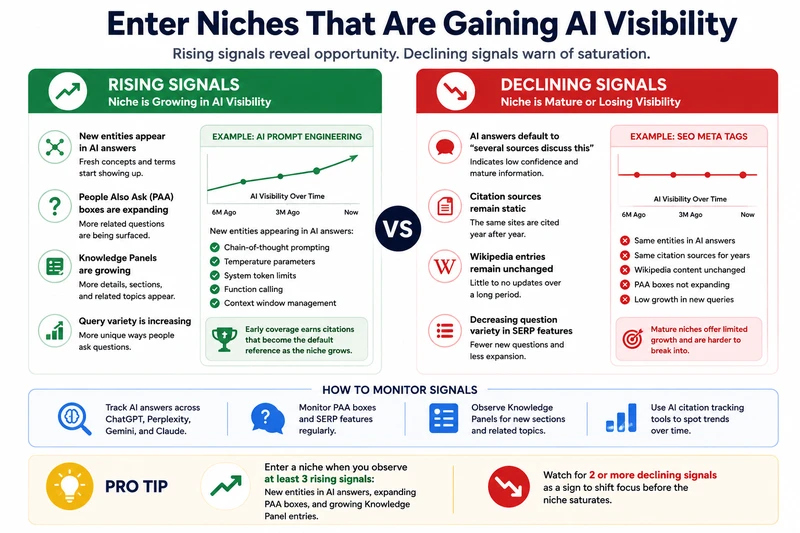
"AI prompt engineering" shows strong rising signals. Entities like chain-of-thought prompting, temperature parameters, and system token limits appeared in AI answers over the past year. "SEO meta tags" shows mature signals. Citation sources have remained static for years. The prompt engineering niche wins because early entity coverage earns citations that become the default reference as the niche grows. Monitoring these signals through regular AI citation tracking helps identify the optimal entry window before a niche matures and competition solidifies.
Pro tip: Enter a niche when you observe at least three rising signals, such as new entities appearing in AI answers, expanding PAA boxes, and growing Knowledge Panel entries. Watch for two or more declining signals as a sign to shift focus before the niche saturates.
9. AI Answer Format Compatibility
AI Overviews, ChatGPT, and Perplexity favour content with clear extraction structure. Bullet lists, comparison tables, step-by-step instructions, and numbered checklists rank higher. Niches where answers naturally fit these structured formats have higher AI extraction probability. Narrative-heavy niches where answers require long-form prose summarisation perform worse.
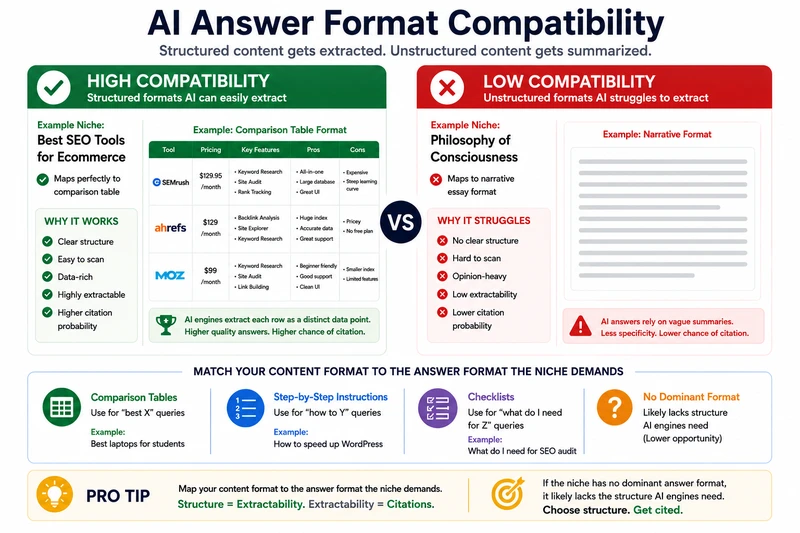
"Best SEO tools for ecommerce" maps perfectly to a comparison table. Each row, with tool name, pricing, key features, pros, and cons, offers a distinct data point ChatGPT extracts reliably. "Philosophy of consciousness" maps to narrative essays with no natural tabular structure. AI answers resort to vague summaries lacking the specificity that drives user citations. The comparison-friendly niche wins because structured formats give AI engines precise extractable data points. They produce higher-quality answers than paraphrased prose. This directly increases the likelihood that your content becomes the cited source.
Pro tip: Map your content format to the answer format the niche demands. Use comparison tables for "best X" queries. Use step-by-step instructions for "how to Y" queries. Use checklists for "what do I need for Z" queries. If the niche has no dominant answer format, it likely lacks the structure AI engines need.
10. Competitive Citation Moat
Some niches have a single domain that owns the foundational reference. This could be the industry standard guide, the government health portal, or the comprehensive Wikipedia article covering every subtopic. AI engines default to these sources because they carry institutional authority that no new entrant can match. Niches without these citation moats offer fair competition where quality alone determines which source AI answers reference.
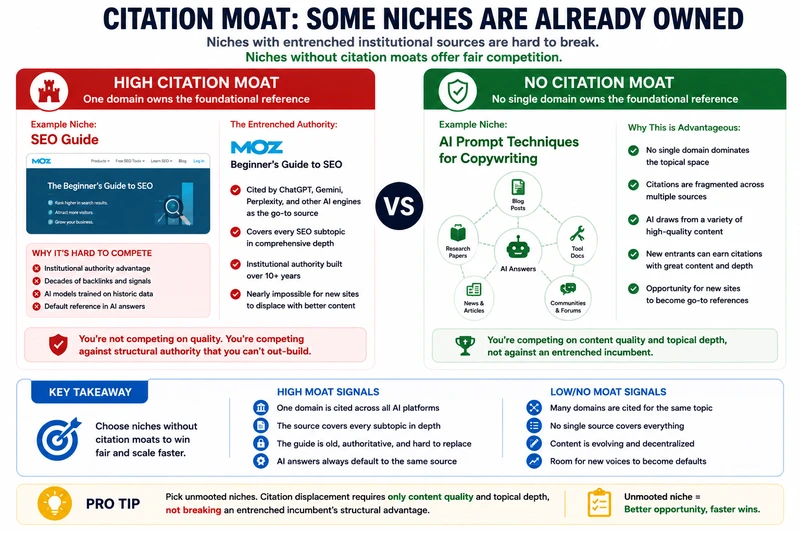
"SEO guide" has a high citation moat. Moz's Beginner's Guide to SEO is cited by ChatGPT, Gemini, and Perplexity as the foundational reference for nearly every SEO subtopic. A new site cannot displace this with better content alone because the institutional authority predates any new entrant. "AI prompt techniques for copywriting" has no citation moat. No single domain owns the foundational reference. Citations are fragmented across blog posts, research papers, and tool documentation. The unmooted niche wins because citation displacement requires only content quality and topical depth, not breaking an entrenched incumbent's structural advantage.
Pro tip: If a niche has a strong citation moat, enter only through a unique subtopic the incumbent covers poorly or ignores entirely. If there is no moat, aim directly for the top with a comprehensive pillar page covering the full topic breadth.
Frequently Asked Questions
Should I choose a niche I am an expert in or one I can research with AI?
Choose a niche where you can add genuine judgment, not just information. If you have domain expertise, use it to deepen the judgment gap. If not, choose a niche with low experience barrier and wide judgment gap where research plus perspective produces defensible content AI cannot replicate.
How do I measure AI citation concentration for a niche?
Run three to five representative keywords through ChatGPT, Perplexity, and Gemini. Log every domain cited in the answers. If the same three domains appear in 80% of responses, concentration is high. If citations spread across ten or more sources, the niche is open for new entrants.
Can a review-based niche work in the AI era?
Yes, but only if you can sustain genuine first-hand experience across dozens of articles. Review-based niches that survive the AI transition are those where product quality and differentiation matter. Speciality tools, travel experiences, or services where personal testing adds value that AI summaries cannot provide are good candidates.
What is the single most important factor for niche selection?
The judgment gap. Everything else determines whether you can enter the niche. The judgment gap determines whether your content survives the AI summary. Without a wide judgment gap, your content competes directly with AI-generated answers on equal footing and loses the differentiation that drives citations.