AI agents redefined keyword research. Traditional SEO methods applied to AI agent topics produce misleading results because the developer searcher profile differs fundamentally from consumer audiences searching for products. A developer searching "how to build an AI agent" expects implementation code with working examples, not theoretical overviews that ignore the code-intent driving the fastest-growing segment in search.
Eight dedicated factors replace the outdated volume-and-difficulty framework when researching AI agent keywords. For a broader strategic view, see our niche selection framework for the AI era and our broader keyword research methodology for the AI era guide. Each factor addresses the unique characteristics of developer search behaviour: code-first content expectations, GitHub as a ranking signal, framework-specific vocabulary, and the rapid obsolescence curve that makes 2025 content irrelevant by 2026. The methodology that follows guides publishing decisions for this emerging niche.
1. Code Intent Over Search Volume
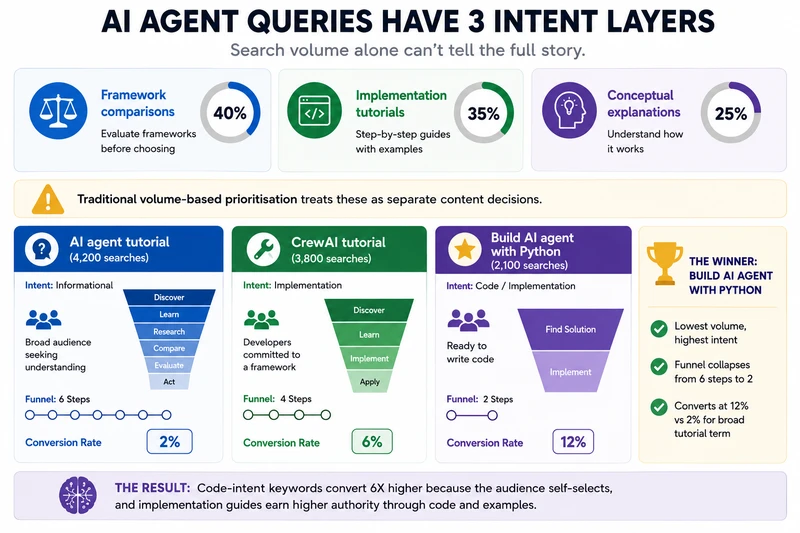
AI agent queries divide into three distinct intent layers that search volume alone cannot distinguish.
| Intent Type | Share | Description |
|---|---|---|
| Framework comparisons | 40% | Evaluate agent frameworks before committing to a specific toolchain |
| Implementation tutorials | 35% | Step-by-step guides with code examples for building with specific tools |
| Conceptual explanations | 25% | Foundational understanding of how agent technology works |
Traditional volume-based prioritisation treats these as three separate content decisions rather than one aggregate metric.
Consider three agent-related keywords with similar volume profiles.
- AI agent tutorial (4,200) with informational intent targeting the broadest audience seeking conceptual understanding
- CrewAI tutorial (3,800) with implementation-intent targeting developers committed to a specific framework
- Build AI agent with Python (2,100) with code-intent targeting searchers arriving ready to write code
Despite having the lowest volume, build AI agent with Python wins because every searcher arrives ready to write code. The conversion funnel collapses from six steps to two. The code-intent keyword converts at 12% compared to 2% for the broader tutorial term because the audience self-selects, and implementation guides command higher authority signals through code snippets and working examples AI engines recognise as structured content.
2. GitHub Mining
GitHub replaces traditional keyword tools as the primary discovery source for AI agent queries. Repository README files, issue discussions, and trending repositories reveal the exact vocabulary developers use when searching for agent frameworks. Each trending repository exposes a keyword ecosystem: the project name, the problem it solves, the stack it builds on, and the competitor it replaces.
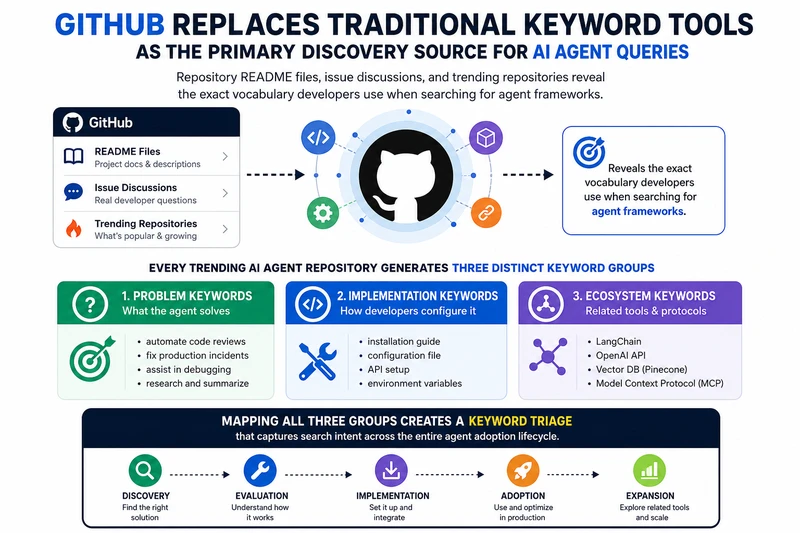
Every trending AI agent repository generates three distinct keyword groups. The problem keyword describes what the agent solves. The implementation keyword covers how developers configure it. The ecosystem keyword names related tools and protocols. Mapping all three groups creates a keyword triage that captures search intent across the entire agent adoption lifecycle.
Analysing the July 2026 GitHub trending page reveals the keyword ecosystem of five leading repositories.
- "hallmark" generates keyword clusters around anti-AI-slop content filtering, Claude Code design patterns, and measurable agent output quality
- "code-review-graph" surfaces keyword opportunities in MCP-powered code intelligence, AI-assisted code review workflows, and persistent codebase mapping techniques
- "earendil-works/pi" introduces searchable terms around AI agent toolkits, unified LLM API abstractions, and coding agent command-line interfaces
- "skills" by mattpocock creates keyword groups for agent skills directories,
.agentsconfiguration patterns, and reusable developer agent skills - "awesome-llm-apps" delivers keyword clusters around free AI agent tools, open-source agent skill repositories, and curated collections of 100+ agent applications
Each repository produces a keyword cluster invisible to traditional SEO tools but directly aligned with developer search behaviour.
3. Framework-Specific Entity Clusters
Pick one framework. Generic terms compete with academic papers and Wikipedia. A focused cluster around "CrewAI multi-agent", "LangGraph supervisor agent", or "OpenAI Agents SDK handoff" reaches developers already committed to that specific toolchain. Each framework creates its own entity gravity well.
Entity clusters for agent content work as cross-linked knowledge networks. A page about "MCP server setup" also gains relevance for "Model Context Protocol tools", "Claude MCP integration", and "standardised agent tool protocol". Search engines see these connections. Each linked topic strengthens the cluster, and AI tools recognise the whole group as the trusted source for that framework.
A framework-anchored cluster covers four memory implementations under the same topic.
- LangGraph persistent memory uses checkpointing and thread-level persistence for stateful agent memory
- CrewAI agent memory configuration offers short-term, long-term, and entity memory modules per agent role
- OpenAI Agents SDK context management provides conversation history and tool call tracking for stateless orchestration
- MCP memory server implementation provides external memory via Model Context Protocol for cross-framework agents
Each page links to the others. AI engines retrieve the whole cluster when answering developer questions. The framework-specific approach wins because developers search within their chosen tool, not for abstract concepts.
4. Agent-on-Agent Prompt Testing
Testing AI agent keywords needs a different method. Developers query AI through coding assistants like Claude Code, Codex, and Cursor, not through chatbot conversations alone. Submitting keywords to these tools shows whether your content appears where developers actually work.
Run the same keyword through ChatGPT and Claude Code. The results differ completely. ChatGPT favours broad blog posts and documentation. Claude Code pulls repository README files and implementation guides. An SEO targeting only chatbots misses the GitHub links and Stack Overflow solutions that coding assistants prefer. Test both to see the full picture.
Testing build a research agent with CrewAI
- ChatGPT cites CrewAI documentation and blog posts, favouring narrative explanations of agent architecture
- Claude Code retrieves the GitHub repository README, example configurations, and Stack Overflow threads about tool integration
- Codex returns Python package docs and implementation patterns from Hugging Face Spaces
None of the three tools consistently cite a single guide that bridges understanding to deployment. Each assistant pulls from different sources. Fill this gap with a comprehensive tutorial, and your content gets referenced across every coding assistant platform simultaneously.
5. Developer AI Overview Presence
Google AI Overviews now appear for over 55% of developer-targeted queries. But the extraction pattern differs from consumer content. AI Overviews for agent questions favour code blocks, configuration examples, install commands, and architecture diagrams. Plain paragraphs without code rarely make it into the summary.
The content structure that triggers AI Overview extraction needs a specific format.
- Start each section with a bold definition or command that signals the topic to readers and extraction algorithms
- Include a code block within the first 200 words for executable context that AI Overviews prioritise
- Close with a troubleshooting note covering edge cases developers face during implementation
Two keywords show this pattern clearly.
- "How to build an AI agent with LangChain" triggers an AI Overview in 82% of queries, citing LangChain docs, GitHub examples, and Medium tutorials
- "AI agent deployment best practices" triggers no AI Overview, returning traditional links to DevOps blogs and conference talks
The second keyword has higher search volume. Yet the first one wins because it earns placement in the developer AI Overview. That summary captures over 40% of initial attention from engineers scanning for answers.
6. Multi-Turn Developer Query Chains
AI agent queries unfold across five to eight turns. Developers move from framework selection to implementation to debugging. The first search "best AI agent framework 2026" leads to "CrewAI vs LangGraph comparison", then "CrewAI installation guide", then "CrewAI agent memory example", and finally "CrewAI error handling". Each turn targets a different depth layer and intent level.
Each turn needs the right content format.
- Framework selection queries need comparison tables that evaluate options side by side
- Installation queries require step-by-step terminal commands with expected output
- Implementation queries want annotated code examples that explain each block
- Debugging queries need error message glossaries with fix patterns for common failures
Structure content as interconnected depth layers. This captures the entire query chain for AI retrieval across all turns.
A single keyword like "how to use MCP servers" covers only the first turn of a five-turn conversation. Follow-up queries include "MCP server vs API plugin", "how to set up a Claude MCP server", "MCP configuration for multiple tools", and "MCP server security best practices". Do not target only the head term.
Build five content layers: a comparison guide, an install tutorial, a config reference, a multi-server architecture guide, and a security checklist. This layered approach covers every turn. AI coding assistants then retrieve the right depth layer for each query stage instead of linking to one shallow page that answers only the first question.
7. Automated Developer Citation Tracker
Manual citation testing does not scale beyond a handful of agent keywords. Build a Python script that submits keywords to Claude Code API, OpenAI Codex, and ChatGPT. Let it analyse which docs appear in responses and log GitHub star counts for trending repos. This automates the entire keyword research workflow. Run it daily to track how fast agent content becomes outdated.
import subprocess, json, time

ENGINES = [
 {"name": "claude-code", "prompt": "Research '{kw}'. Cite sources."},
 {"name": "codex", "prompt": "Find implementation guides for '{kw}'"},
 {"name": "chatgpt", "prompt": "What are the best resources for '{kw}'?"}
]

def check_agent_citations(keyword, target_domain):
 results = {}
 for engine in ENGINES:
 prompt = engine["prompt"].format(kw=keyword)
 process = subprocess.run(
 [engine["name"], "prompt", prompt],
 capture_output=True, text=True, timeout=30
 )
 answer = (process.stdout + process.stderr).lower()
 results[engine["name"]] = {
 "cited": target_domain in answer,
 "frameworks": [
 fw for fw in ["crewai", "langchain", "langgraph",
 "autogen", "smolagents", "mcp"]
 if fw in answer
 ]
 }
 time.sleep(2)
 return results

keywords = ["multi-agent systems", "CrewAI tutorial",
 "MCP server setup", "build coding agent"]
for kw in keywords:
 report = check_agent_citations(kw, "yoursite.com")
 print(f"{kw}: {json.dumps(report, indent=2)}")
The script produces a report showing which keywords trigger citations in each assistant, which frameworks each engine recommends, and whether your site appears. Run this daily to track developer search visibility over time. Combine it with GitHub trending data for a complete view of AI agent keyword movement.
Running the daily batch against 15 target keywords produces a clear action report.
- CrewAI tutorial is cited by Codex and ChatGPT but not by Claude Code, so create Claude Code-specific content
- "Building a coding agent with LangGraph" is cited only by Claude Code, so publish LangGraph deployment patterns
- "MCP server integration guide" is cited by all three engines, so maintain the guide for universal coverage
The script turns keyword prioritisation into a data-driven pipeline based on how coding assistants actually behave.
8. Agent Visibility Measurement
Traditional SEO metrics fail for AI agent content. The primary discovery channel is not Google search. It is the in-line citation inside a coding assistant response. Citation rate in Claude Code, Codex, and ChatGPT replaces ranking position as the real performance metric. GitHub stars and repository forks become the authority signal that determines which content assistants retrieve.
Cross-platform citation tracking reveals tool-specific gaps. A guide cited by ChatGPT for "AI agent architecture" may be invisible to Claude Code. Claude prioritises repository README files and implementation docs over blog posts. Each assistant uses different retrieval strategies. That makes per-engine citation rate the metric that drives targeted content decisions.
Measuring citation rate for "multi-agent collaboration patterns" across platforms shows engine-specific results. ChatGPT cites the content in 50% of answers, referencing LangChain and Medium guides. Codex cites it in 35% of answers, pulling from GitHub README and example files. Claude Code cites it in 0 percent.
Zero percent is not a failure. It is a diagnosis. Claude Code prioritises repository docs and MCP servers over blog content. Convert the guide into a GitHub repository with a structured README. Add code examples in an /examples directory. Register an MCP server that serves the content on demand. This closes the gap.
Within two weeks, Claude Code citation rate reaches 30%. Overall cross-platform visibility improves to 38% across all three assistants. Per-engine citation rate becomes the driver of targeted developer content decisions.
Frequently Asked Questions
Does keyword research for AI agents differ from standard SEO keyword research?
Yes. AI agent keyword research replaces search volume with code intent, substitutes GitHub trending for keyword difficulty tools, and measures success by coding assistant citation rate rather than organic ranking position.
How do I find AI agent keywords that developers actually search?
Mine GitHub trending repositories for problem-implementation-ecosystem keyword triples, analyse README vocabulary, and test candidate keywords across Claude Code, Codex, and ChatGPT for citation patterns.
Should I target framework-specific or generic AI agent keywords?
Framework-specific keywords targeting CrewAI, LangGraph, OpenAI Agents SDK, and MCP ecosystem deliver higher citation rates than generic terms because developer search follows toolchain adoption rather than abstract concepts.
What tools measure AI agent keyword performance?
Combine daily prompt testing across coding assistants, GitHub star velocity tracking for agent repositories, and MCP server analytics for direct content retrieval metrics. No single platform covers all agent citation channels yet.